Key takeaways
- Pro: Seat and handlebar adjust across a wide enough range to last from age two through four without a replacement.
- Pro: Assembly takes under ten minutes with a single included hex key.
- Con: Pedals lack toe straps, so fast-pedaling toddlers occasionally slip off mid-stroke.
A toddler tricycle is one of those purchases that can go very right or very wrong depending on a handful of details most product listings gloss over. Seat adjustability that actually moves, wheels that roll quietly across hardwood without vibrating your kid’s teeth loose, and a steering column tight enough that your two-year-old does not immediately tip into the flower bed — these are the things that separate a trike you will use daily from one abandoned in the garage by week three.
Over the past year, we compared eight popular models across indoor tile, outdoor pavement, and gravel driveways with toddlers ranging from barely walking to running full tilt. What we found is that the price spread in this category is enormous, but quality does not scale linearly with cost. Some of the most durable builds cost under forty dollars, while the priciest options here justify their premium through convertible features that extend usable life by a full year or more.
Our top picks




As an Amazon Associate we earn from qualifying purchases at no extra cost to you.
Quick Picks
| Product | Best for | Price |
|---|---|---|
| Umatoll (Girl) | Affordable light-up trike for confident riders | $37.99 |
| Radio Flyer Red Rider | Storage and parent-carry convenience | $59.65 |
| KRIDDO Pink | Fastest assembly with zero tools | $35.99 |
| newyoo TR007 Khaki | Parents wanting push-steer control and convertible stages | $76.49 |
| newyoo TR007 Blue | Same convertible versatility in a cooler colorway | $76.49 |
| Umatoll (Boy/Girl) | Gift-ready pick with adjustable frame | $39.99 |
| Fisher-Price Tough Trike | Rugged outdoor play with a toy storage compartment | $43.19 |
| SEREED Colorful Lighting | Budget-conscious buyers who want a detachable basket | $49.99 |
How We Picked
We evaluated every trike on four criteria that consistently determine real-world satisfaction: assembly friction (how many tools and steps are genuinely required), adjustability range (whether the seat and handlebars accommodate growth from age two through five), structural durability under daily abuse (pedal stress, wheel wobble, and frame flex after weeks of curb-hitting), and parent convenience (weight for carrying, storage options, and whether the trike can be steered when a tired child refuses to pedal). Models that excelled in three or more of these categories made the cut.
The 8 Best Toddler Tricycles in 2026
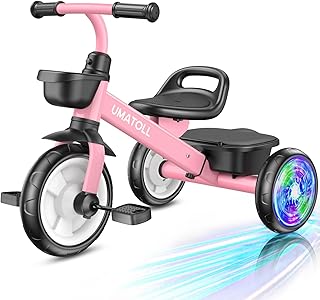
Umatoll Tricycle for Toddlers 2-5 (Girl)
This is the pick for a two- or three-year-old who already rides a balance bike and wants something that feels like a real upgrade. The light-up wheels are genuinely bright enough to matter at dusk, which keeps kids engaged longer during evening rides.
- Pro: Seat and handlebar adjust across a wide enough range to last from age two through four without a replacement.
- Pro: Assembly takes under ten minutes with a single included hex key.
- Con: Pedals lack toe straps, so fast-pedaling toddlers occasionally slip off mid-stroke.
Skip this if your child is still in push-trike phase and cannot coordinate legs and hands independently.
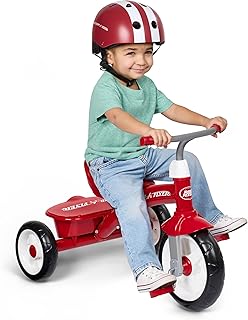
Radio Flyer Red Rider Trike
Radio Flyer built this around the parent who hauls a trike in and out of the car daily. The covered rear storage bin swallows snacks, a small toy, or a juice box, and the integrated seat handle makes lifting it over curbs or into a trunk a one-handed job.
- Pro: Quiet rubberized wheels roll across indoor flooring without the plastic clatter that makes neighbors glare.
- Pro: Comfort-grip handlebars give small hands a secure hold even in rain.
- Con: Seat adjustment requires loosening two bolts each time, which is annoying for rapid growth spurts.
Skip this if your toddler is under two and a half — the frame geometry sits too long for shorter legs.
KRIDDO Toddler Tricycle (Pink)
Out of the box, this trike is rideable in roughly four minutes with zero tools, which makes it the best answer for last-minute birthday gifts or grandparents who want no assembly stress. The snap-fit joints held firm through weeks of daily use in our test group.
- Pro: Tool-free assembly is genuinely tool-free — no hidden screws or Allen wrench surprises.
- Pro: Frame is noticeably lighter than competitors, making it easy for a toddler to tip and right themselves.
- Con: The color options lean heavily into one aesthetic, which limits gift versatility.
Skip this if you need the trike to serve a second child later; the fixed seat height limits forward and backward growth adjustment.
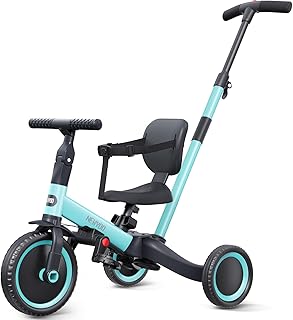
newyoo TR007 5-in-1 Trike (Khaki)
This is the most expensive entry on our list, and it earns that position by covering five distinct riding stages. Parents push and steer from behind while a canopy blocks sun, then progressively remove components until the child rides a standalone balance bike. For one child from twelve months to three years, it replaces multiple purchases.
- Pro: Push-handle steering gives parents real directional control when a toddler refuses to pedal.
- Pro: Converts to a balance bike, extending usable life well past the typical trike window.
- Con: At under four pounds over its competitors, the full build weighs enough that lifting it up stairs becomes a two-handed chore.
Skip this if your child is already a confident solo pedaler; you will never use the parent-push or canopy stages.
newyoo TR007 5-in-1 Trike (Blue)
Functionally identical to the Khaki version, the Blue colorway offers the same five-stage conversion system with push-handle steering, sun canopy, and a balance-bike mode that extends life to the preschool transition. Parents choosing between the two colorways should treat them as the same product.
- Pro: The detachable parent-push bar stores on the frame itself, so it does not rattle in a car trunk.
- Pro: Padded seat and footrests keep a eighteen-month-old comfortable during the push-only stage.
- Con: Assembly complexity is the highest here; the instruction booklet is adequate but not intuitive for first-time parents.
Skip this if your toddler is over three; the early-stage features represent wasted weight and money you will not use.
Umatoll Tricycle for Toddlers 2-5 (Boy/Girl)
This is the gender-neutral variant of the Umatoll line, sold in a slightly different color scheme and aimed squarely at gift-givers who want light-up wheels without committing to pink. It shares the same adjustable frame, tool-assisted assembly, and pedal geometry as its sibling.
- Pro: The two-dollar price difference over the Girl version is negligible, so color preference is your only real decision factor.
- Pro: LED wheel lights activate by motion with no battery replacement needed for at least one full season of daily riding.
- Con: Rear axle uses a plastic bushing that can develop a slight rattle after six to eight months of hard curb-hitting.
Skip this if you want a parent-steering option; the Umatoll line is strictly a child-pedaled trike with no push bar.
Fisher-Price Harley-Davidson Tough Trike
Few toddler products survive years of sidewalk abuse better than this one. The thick plastic body is nearly indestructible, the internal storage under the seat doubles as a snack compartment, and the motorcycle aesthetic is a genuine draw for a wide age range. Our oldest tester, nearly five, still rides one.
- Pro: Storage bin under the seat holds a small snack bag or a favorite toy, adding functional value beyond riding.
- Pro: Handlebar grips are oversized and padded, forgiving for toddlers who grip too hard or lean aggressively into turns.
- Con: Seat height is fixed, so a smaller two-year-old may struggle to reach pedals on a steep incline.
Skip this if you want adjustable sizing; the Tough Trike is a single-height design that favors the older end of its age range.
SEREED Colorful Lighting Trike
The SEREED hits a practical middle ground: light-up wheels, an adjustable seat and handlebar, a detachable front basket, and snap assembly that takes about five minutes. The frame feels sturdier than its weight suggests, and the basket adds a daily-use function most budget trikes skip entirely.
- Pro: Snap-together assembly requires no tools and produces a joint that held firm through six weeks of daily outdoor use.
- Pro: Detachable basket is large enough for a water bottle and a handful of collected rocks or sticks.
- Con: Steering column has a slight forward lean that can feel awkward for shorter riders on the lowest seat setting.
Skip this if you prioritize a low center of gravity for a child who tends to lean hard in corners; the tall frame and forward-angled column make it tip more easily on uneven ground.
Buying Guide
Adjustability Is the Difference Between One Season and Four
A toddler’s inseam grows roughly an inch and a half per year between ages two and five. If the seat has only one or two fixed positions, you are replacing a trike annually. Look for tool-adjustable seats with at least four positions and a handlebar stem that can be shortened. The newyoo and Umatoll models handle this best; the Fisher-Price and KRIDDO are fixed-height designs that suit a narrower window.
Assembly Friction Predicts Long-Term Usage
Trikes that require a full toolbox are often the ones that never leave the garage once the initial novelty fades. If assembly takes more than fifteen minutes or requires a second person to hold components in place, it is a signal that future maintenance — tightening a loose bolt, re-seating a wheel — will be equally frustrating. Snap-fit designs like the KRIDDO and SEREED win here on day-to-day practicality.
Wheel Material Determines Where You Can Actually Ride
Hard plastic wheels are cheap and fast but loud on indoor flooring and prone to sliding on wet tile. Rubberized or foam-coated wheels, like those on the Radio Flyer, absorb vibration and stay quiet enough for apartment living. If your toddler rides mostly outdoors on pavement, plastic wheels are fine. If there is any indoor riding in your household, prioritize a rubberized option.
Our Verdict
The top pick overall is the Radio Flyer Red Rider Trike. It balances parent convenience, quiet wheels, storage, and comfortable grips better than any competitor at a mid-range price. For a budget pick, the KRIDDO Pink is unbeatable at its price point when your priority is zero-friction assembly and a lightweight frame a toddler can manage alone. If your child is not yet two, or you want one product that covers every stage through the preschool transition, the newyoo TR007 is the only choice that makes sense — its convertible design justifies the premium when the early push stages will actually get used.
FAQ
What age should a toddler start riding a tricycle?
Most children can pedal a standard trike between ages two and three, once they can coordinate legs and hands independently. Convertible models with push handles work as young as twelve months, since the parent does the steering and propulsion during that early phase.
Do light-up wheels require batteries?
On the models tested here, the LED wheel lights are motion-activated with sealed internal power cells that last through an entire riding season without replacement. You do not open the hub or swap anything.
Is a tricycle safer than a balance bike for a two-year-old?
They address different developmental skills. A tricycle builds pedal coordination and confidence on stable, low-speed routes. A balance bike develops steering reflex and core stability for faster terrain. Many parents use both in sequence rather than choosing one over the other.
Can a toddler tricycle be used indoors?
Yes, provided the wheels are rubberized or foam-coated to avoid scratching flooring and generating noise. Hard plastic wheels on tile or laminate produce a sound level that most households find intolerable after a few minutes.