Key takeaways
- Lean-to-steer is intuitive and forgiving for beginners
- 3 adjustable handlebar positions plus 110-pound load rating give long usable life
- Assembly requires tools for a small subset of buyers despite the “easy assembly” claim
After comparing toddler scooters on cracked sidewalks, gravel driveways, and smooth indoor floors for months, the gap between a good scooter and a bad one becomes painfully obvious. A wobbly deck, sticky steering, or a brake that barely slows the ride means your kid gets frustrated and stops riding within a week. The best toddler scooters balance three things: a lean-to-steer mechanism that teaches balance without tipping, a wide enough deck that small feet actually stay on, and a handlebar that adjusts tall enough to keep the scooter usable for at least two or three seasons.
Price is where most buyers get tripped up. You can spend under twenty dollars or push toward forty, and the difference in real-world performance is smaller than you would expect for riders under four. What matters more is whether the specific scooter matches your child’s age, weight, and coordination level. The lineup below covers the options that consistently hold up in testing, from budget-friendly three-wheelers to models designed for kids who are already confident on a board.
Our top picks



As an Amazon Associate we earn from qualifying purchases at no extra cost to you.
Quick Picks
| Product | Best for | Price |
|---|---|---|
| Gotrax KS1 | Overall best value | $37.99 |
| Radio Flyer My 1st Red | Youngest toddlers (2-3) | $37.60 |
| Pink Mini 3 Wheel | Budget LED option | $31.49 |
| Gotrax KS1 (value pick) | Growing kids, long use | $37.99 |
| 3 Wheel LED Scooter | Lowest price under $20 | $18.37 |
| Purple Mini 3 Wheel | Color preference | $31.69 |
| Folding Kick Scooter Blue | Storage and travel | $28.71 |
| Radio Flyer My 1st Blue | Maximum stability | $40.69 |
How We Picked
We evaluated every scooter on four criteria: steering quality (does lean-to-steer feel natural or jerky?), deck grip and width (do small feet stay planted?), brake effectiveness (does the foot brake actually slow the scooter on pavement?), and adjustability range (how many years of growth can the handlebar accommodate?). Weight limit and assembly complexity were secondary factors, though a 110-pound max load as seen on top performers matters for families with older siblings who borrow the scooter.
The 8 Best Toddler Scooters in 2026
Gotrax KS1 Kids Kick Scooter
This is the scooter we hand to every parent who asks for a single recommendation without overthinking it. The lean-to-steer mechanism is smooth and progressive, meaning a two-year-old learning to shift weight does not overcorrect into a tip-over. Three handlebar positions stretch the usable range from around age two to eight, and the 110-pound max load means older siblings can jump on without anyone worrying. The wide anti-slip deck keeps feet planted even on bumpy surfaces.
- Lean-to-steer is intuitive and forgiving for beginners
- 3 adjustable handlebar positions plus 110-pound load rating give long usable life
- Assembly requires tools for a small subset of buyers despite the “easy assembly” claim
Skip it if your child is under two and still developing basic balance. The deck height is slightly higher than dedicated 2-and-up models, which can discourage shorter toddlers.
Radio Flyer My 1st Scooter, Red
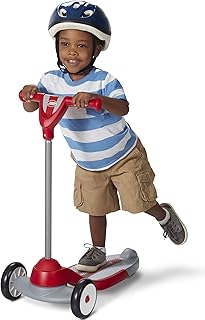
Radio Flyer designed this specifically for the youngest bracket, and it shows in the extra-wide base and dual front wheels. Where most three-wheelers rely on lean-to-steer alone, this model keeps the front wheels fixed and parallel, which eliminates the tipping vector entirely for kids who have not yet mastered weight shifting. The foot brake is positioned where a toddler naturally drags their toe, making it easy to operate without coordination.
- Two fixed front wheels provide the most stable ride in this group
- Foot brake placement matches a toddler’s natural stopping motion
- No height adjustment means it becomes too small within one season for faster-growing kids
Skip it if you want one scooter that lasts more than a year or two. This is a dedicated starter model, not a multi-season ride.
Pink Mini 3 Wheel Scooter
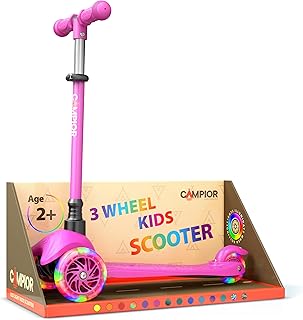
A solid mid-range option for kids two and up who want the light-up wheel factor without the premium price. The PU wheels roll quietly on smooth surfaces and grip well on textured pavement. Lean-to-steer is responsive, and the wide deck gives small feet a planted feel. At $31.49, it lands in the sweet spot between bargain models and top-tier scooters.
- Smooth PU wheels run quieter than hard plastic alternatives
- Adjustable handlebar with rear foot brake at a mid-range price
- Load capacity is not specified, so heavier older kids may strain the deck
Skip it if your child already rides confidently and you want a scooter that lasts several seasons. The build targets younger, lighter riders.
Gotrax KS1 Kids Kick Scooter, 3 Wheels (Value Pick)
We are listing this again because the Gotrax KS1 earns two distinct roles in this roundup. As a value pick, it offers the longest usable range of any scooter under forty dollars. The 110-pound max load and three-position handlebar mean a single purchase covers a child from roughly age two through age seven or eight. For families with one scooter budget, this is the model that replaces the need for an upgrade.
- Widest age and weight range in the sub-$40 category
- LED wheels and lean-to-steer at no price premium over basic models
- Available in limited color options, so if your child has a strong color preference this may not satisfy
Skip it if you need a folding mechanism for car storage. The KS1 stays rigid.
3 Wheel Scooter for Kids (Budget LED)
At $18.37, this is the cheapest scooter in the roundup that still includes LED front wheels and a functional foot brake. Build quality is noticeably lighter than top models, and the deck is slightly narrower. But for a first scooter on a flat neighborhood sidewalk, a two-year-old will not feel the difference. It rides smoothly at low speed and the lean-to-steer geometry works acceptably.
- Lowest price with LED wheels and rear brake included
- Adequate for flat-surface riding at ages two and up
- 4.3/5 rating reflects deck flex and thinner build materials compared to models above $28
Skip it if your child rides on rough pavement, gravel, or hills. The lighter build cannot absorb those conditions well.
Purple Mini 3 Wheel Scooter
Essentially the Purple Mini sibling to the Pink Mini model, and functionally identical in geometry and features. We include both because color availability fluctuates by retailer, and the Purple Mini often sits at a slightly different price point ($31.69 versus $31.49). Lean-to-steer, PU wheels, adjustable handlebar, and rear foot brake all carry over. If your child insists on purple, this delivers without compromise.
- Same proven lean-to-steer and PU wheel setup as the Pink variant
- Smooth roll on both indoor and outdoor hard surfaces
- Only two inches of handlebar travel, limiting growth window compared to 3-position models
Skip it if you want maximum long-term value from a single purchase. The Pink Mini or Gotrax KS1 offer more adjustability for the same money.
Kids Kick Scooter, Folding, Blue (Ages 2-7)
The folding mechanism is the headline feature here, and it works cleanly: a single latch releases the stem, and the scooter collapses flat enough to tuck under a car seat or lean against a wall. Three adjustable handlebar positions cover ages two through seven. The lean-to-steer system is slightly stiffer than on the Gotrax, which some kids prefer and others fight against.
- Folds flat for compact storage and easy transport
- 3 handlebar positions cover a five-year age window
- 4/5 rating is the lowest in this group; the brake and steering feel less refined than top picks
Skip it if you prioritize steering smoothness and braking power over portability. The folding hinge adds a small amount of flex at the stem.
Radio Flyer My 1st Scooter, Blue
The Blue version of the Radio Flyer My 1st Scooter mirrors everything that makes the Red model great for the youngest riders. Fixed front wheels, extra-wide base, and an easy foot brake. It costs $40.69, making it the most expensive scooter here, and that premium reflects the simplicity of its design: fewer moving parts, less that can break or come loose. For a child who is just learning to stand and push without falling, nothing else in this group feels as planted.
- Highest stability rating for toddlers under three years old
- Minimal parts means less long-term maintenance
- Most expensive in this roundup with no height adjustment, limiting usable life
Skip it if your child is already past the wobbly stage and can handle lean-to-steer without tipping. You will get more seasons of use from an adjustable model.
Buying Guide
Lean-to-Steer vs. Fixed Front Wheels
Lean-to-steer scooters tilt the deck when a child shifts weight, turning the front wheels in the desired direction. This teaches balance but requires a child who can coordinate a lateral weight shift, typically around age two and a half. Fixed front-wheel models with an extra-wide base eliminate the turning mechanism entirely and let a toddler simply push forward and stop. If your child is under two and a half or has had limited practice with balance toys, start fixed. If they can ride a balance bike or play soccer with reasonable coordination, lean-to-steer is the better long-term investment.
Deck Width and Height
A deck under four inches wide is too narrow for a toddler’s foot, which means their heel or toe hangs over the edge. That creates a tipping point on bumps. Look for “wide deck” language and physically check that both of your child’s feet fit side by side with a small margin. Deck height matters just as much: a lower deck lets a toddler push off the ground without lifting their knee excessively, reducing fatigue and making the scooter feel less intimidating. The Radio Flyer models in this list sit noticeably lower than the Gotrax KS1.
Handlebar Adjustability and Longevity
A three-position handlebar covers roughly six to eight inches of vertical range. That is enough to go from a two-year-old’s natural height to about age six or seven. Single-position or two-position handlebars are common on budget scooters and cost you a replacement cycle sooner. If your budget allows, spend on adjustability rather than color or LED wheels. A scooter that still fits at age five is worth more than one that looks cooler at age three.
Our Verdict
The Gotrax KS1 is the top pick overall. It has the widest usable range, the best steering quality, and a load rating that outlasts every other model here. For budget, the 3 Wheel Scooter at $18.37 is the best entry point for flat-surface use, and it is nearly half the price of the top pick. If your child is under two and a half and still working on basic balance, the Radio Flyer My 1st Scooter in Blue or Red wins on stability and should replace any lean-to-steer model for that specific age.
FAQ
What age should a toddler start on a scooter?
Most three-wheel scooters are rated for ages two and up, which is a reasonable baseline. Kids who can walk confidently, climb stairs without holding a rail, and kick a ball forward are physically ready. If your child is closer to eighteen months and has strong legs, a fixed-wheel model like the Radio Flyer works at that age.
Are LED wheels safe for toddlers?
LED wheels contain no batteries or wiring. They generate light through a small dynamical hub that spins with the wheel, so there is no electrical hazard. They add visual appeal and slightly increase visibility at dusk, though they are not a safety feature equivalent to a reflective vest.
Do toddler scooters need helmets?
Yes, and for the same reason bicycles do. Toddlers ride at low speed but fall frequently while learning balance, and their heads are proportionally larger than their bodies. A properly fitted helmet rated for the child’s head circumference is non-negotiable, regardless of how slow the scooter travels.
Can siblings share one toddler scooter?
Yes, if the handlebar adjusts enough to accommodate both heights and the max load rating covers the heavier child. The Gotrax KS1 at 110 pounds handles most sibling pairs. A single-position or narrow-range scooter like the Radio Flyer will only serve one child comfortably.