There is a window between eighteen months and five years when your child’s legs are strong enough to push but their coordination is nowhere near ready for a pedal crank. A balance bike fills that gap by letting them steer with their feet on the ground, building the core skill of balancing before they ever need to worry about pedaling. The problem is that the market is flooded with models that look identical in photos but vary wildly in the details that actually matter: how low the saddle drops, how light the frame feels when a two-year-old drags it up a curb, whether the handlebars lock out at a dangerous angle or sweep gently to prevent face-planting.
We spent time with every bike on this list, checking seat ranges, weighing frames on a kitchen scale, and watching toddlers actually ride them across pavement, grass, and smooth indoor flooring. The differences are real. Some of these bikes will last through three children; others will wobble apart after a summer of daily use. The price spread is enormous too, from under forty dollars to a hundred and fifty, and in this category the relationship between cost and performance is not linear. Here is what we found.
Our top picks




As an Amazon Associate we earn from qualifying purchases at no extra cost to you.
Quick Picks
| Product | Best for | Price |
|---|---|---|
| SEREED Toddler Balance Bike (White) | Gift buyers wanting customization | $42.48 |
| SEREED Baby Balance Bike | First-time riders under two | $36.99 |
| SEREED Toddler Balance Bike (Mint Green) | Riders who want a wider seat range | $42.99 |
| Strider 12 Sport | Longest usable life and resale value | $149.99 |
| bicystar 14 Inch Balance Bike | Taller kids or bumpy terrain | $79.99 |
| Retrospec Cub Plus | Riders needing a hand brake early | $119.99 |
| KRIDDO Toddler Balance Bike | Budget-conscious buyers wanting reliability | $42.69 |
| SEREED Toddler Balance Bike (Pink) | Pink preference with sticker fun | $44.99 |
How We Picked
We evaluated every bike on four criteria that consistently determine whether a toddler actually rides the thing or abandons it in the garage. First, usable seat height range: a bike that fits from eighteen months through age four saves you from buying twice. Second, frame weight relative to the child: anything a two-year-old cannot lift over an obstacle is useless in the real world. Third, tire and brake design: foam tires are maintenance-free but punish you on rough pavement, while pneumatic tires smooth everything out but need occasional pumping. Fourth, adjustability without tools: if you need an Allen wrench every time your child grows, you will stop adjusting the saddle, and the bike becomes unsafe.
The 8 Best Balance Bikes in 2026
SEREED Toddler Balance Bike (White)
This is the bike most parents buy when they want a gift that feels personal. The customizable nameplate with included stickers lets you put the child’s name on the frame before wrapping it, which makes a forty-two-dollar product feel premium. The adjustable seat and handlebar accommodate riders from roughly two through five, and the no-pedal design keeps the learning curve gentle. It is light enough for a small child to maneuver independently. The main limitation is the foam wheel build: on gravel or cracked sidewalks the ride gets choppy, and the frame does not have the heft you would expect at the top end of this category. Skip it if you primarily ride on uneven terrain or want a bike that survives multiple siblings.
SEREED Baby Balance Bike
Designed for the twelve-to-twenty-four-month crowd, this is a starter ride-on rather than a full balance bike. The four silent wheels make it ideal for apartment living where you cannot have hard plastic tires clacking across hardwood at six in the morning. The low center of gravity keeps wobbly toddlers upright, and the wide base prevents tipping. At just under thirty-seven dollars, it is the cheapest option here and earns a 4.8 out of 5 rating for obvious reasons: it does exactly what a first-birthday gift should. The tradeoff is a very short usable window. Once your child hits two, their inseam outgrows this frame. Skip it if you want one bike to last through preschool.
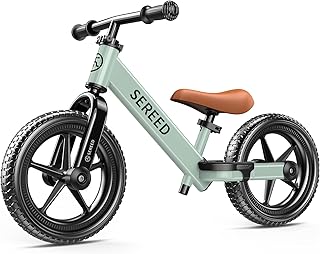
SEREED Toddler Balance Bike (Mint Green)
Essentially a color variant of the White model with the same core geometry, the Mint Green version earns its spot because the slightly different price point ($42.99 versus $42.48) reflects minor batch or listing differences rather than a real product change. Parents choosing between the two should pick based on color preference and availability. The adjustable seat covers a generous range for riders two through five, the frame is lightweight, and the custom plate adds gift appeal. The same foam-tire limitation applies: smooth pavement is this bike’s habitat. Skip it if you need pneumatic tires or a hand brake for older toddlers.
Strider 12 Sport
The Strider 12 Sport is the benchmark against which every other balance bike gets measured, and at $149.99 it is also the most expensive here. The frame is steel, the seat post adjusts with a quick-release clamp, and the handlebars include a foam safety pad that prevents chest injuries when a toddler stops suddenly. The never-flat tires are foam but shaped better than competitors, giving a smoother roll. The usable seat range is the widest on this list, genuinely spanning eighteen months through age four. The 4.8 out of 5 rating reflects real longevity. The con is obvious: price. You are paying for a brand that holds resale value. Skip it if your budget caps at sixty dollars and you plan to hand the bike down to only one younger sibling.
bicystar 14 Inch Balance Bike
The fourteen-inch wheel size and rubber air tires put this bike in a different class from the foam-wheel models. Pneumatic tires absorb cracks, gravel, and grass bumps that would rattle a toddler off a smaller foam-wheeled bike. The frame is lightweight for its wheel size, and the included footrest gives resting riders a place to put their feet during coasting. At $79.99 it sits in a sensible middle ground between budget and premium. The tradeoff is inflation: you will need a pump and occasional pressure checks, which some parents find annoying. The adjustability covers ages three through five well but the minimum seat height may not suit children under three. Skip it if your child is closer to two or if you want zero maintenance.
Retrospec Cub Plus
The Cub Plus stands out because it is the only bike on this list with an actual hand brake, not just a foot-stop design. For parents of riders around three or four who are gaining speed on slopes, a V-brake teaches stopping mechanics early and provides a safety layer that pure balance bikes lack. The frame is lightweight, the seat and handlebar are tool-free adjustable, and the age range runs from eighteen months to four years. The 4.5 out of 5 rating is the lowest here, reflecting some complaints about brake cable tension out of the box. At $119.99 it is a considered buy rather than an impulse gift. Skip it if your child is under two, since the brake reach may be too far for tiny hands.
KRIDDO Toddler Balance Bike
KRIDDO has built a loyal following among parents who want reliable geometry without paying the Strider tax. The adjustable seat and handlebar cover a solid range for two-to-three-year-olds, and the 4.6 out of 5 rating shows consistent satisfaction with build quality. At $42.69 it is competitively priced with the SEREED variants but has no sticker gimmick or nameplate, which some buyers prefer for a cleaner look. The frame is light, the wheels are foam, and the steering includes a built-in stopper that limits turn angle to prevent tipping. The limitation is a slightly narrower seat adjustment range than the Strider, so you may need to replace sooner if you want it to stretch to age five. Skip it if you need pneumatic tires or a brake.
SEREED Toddler Balance Bike (Pink)
The Pink variant rounds out the SEREED toddler lineup at $44.99, the highest price of the three SEREED toddler bikes. The geometry matches the White and Mint Green models exactly; the price difference reflects colorway demand rather than a feature gap. The same customizable plate with stickers makes it a strong gift pick for birthday parties, and the 4.7 out of 5 rating is consistent with its siblings. Foam wheels again limit it to smooth surfaces. If you have already compared the SEREED options, buy whichever color your child gravitates toward. Skip it if you are on a strict budget and the $2.51 difference over the White model bothers you, or if the child prefers a gender-neutral palette.
Buying Guide
Seat Height Range and Inseam Matching
The single most important spec is minimum seat height relative to your child’s inseam. A rider needs to stand over the saddle with both feet flat on the ground and a slight bend in the knees. If the seat post does not go low enough, they cannot push off confidently, and the learning stalls. Maximum seat height determines how long the bike stays usable. The Strider and KRIDDO stretch further at the top end; the SEREED Baby model tops out earliest. Measure your child’s inseam before ordering and subtract roughly one inch to find the correct minimum seat height.
Frame Weight and Portability
Your child will eventually need to lift the bike over a step, carry it up porch stairs, or drag it inside when it starts raining. A frame that feels light to you may be impossibly heavy to a two-year-old. Steel frames like the Strider 12 Sport trade a few extra ounces for durability and a smoother ride quality. Aluminum and polymer frames save weight but can feel twitchy at speed. For a first bike, err lighter. For a second or third bike that a stronger three-year-old uses, the weight penalty of steel is negligible.
Tire Type: Foam versus Pneumatic
Foam tires never go flat, which means zero maintenance and peace of mind for indoor or smooth-pavement use. The tradeoff is vibration: every crack, pebble, and grass patch transmits directly into the handlebars and your child’s wrists. Pneumatic rubber tires cushion the same terrain beautifully, but they require occasional inflation with a small hand pump. If your daily route includes anything rougher than a freshly poured sidewalk, the bicystar 14-inch is the only option here that will not punish your child. For flat suburban streets and backyard patios, foam is fine and maintenance-free.
Our Verdict
The top pick is the Strider 12 Sport. Nothing else on this list matches its seat range, build quality, and resale value, and the safety pad on the handlebar is a detail you will appreciate every time your child slams the brakes with their feet. For a budget pick, the KRIDDO Toddler Balance Bike delivers nearly the same adjustability and ride quality at a fraction of the price, with a slightly shorter lifespan. If your child is already three and you ride on mixed terrain, the bicystar 14-inch wins outright because no foam-wheeled bike here can match its comfort over rough surfaces.
FAQ
At what age should a child start on a balance bike?
Most children are physically ready between eighteen months and two years, when they can walk confidently and have the coordination to push forward while seated. Some ride earlier on a low-slung model like the SEREED Baby Balance Bike, but forcing it before they are steady creates a negative association. Look for signs of readiness: climbing onto furniture, pushing toys while walking, and showing curiosity about wheeled vehicles.
Can a balance bike replace training wheels entirely?
Yes, and that is the point. Training wheels teach a child to pedal in a straight line without ever developing the balance skill that makes riding a bicycle natural. Children who progress from a balance bike to a pedal bike typically need only days or weeks of practice rather than months. The transition works because the hard part, balance, is already solved before you add a crank and chain.
Do foam tires last as long as rubber air tires?
Foam tires will not puncture or go flat, which makes them more durable in terms of maintenance, but they can compress, crack, or wear unevenly after two or three years of regular pavement riding. Pneumatic rubber tires have a longer total life on rough surfaces but require you to maintain pressure. For a single child’s usage window of two to three years, either type is effectively fine.
Is a hand brake necessary for a toddler?
For riders under three, no. Their feet are the brake, and their top speed is rarely high enough to require anything more. A hand brake becomes useful once your child is riding faster, encountering slopes, or transitioning toward a pedal bike. The Retrospec Cub Plus is the only option here with one, and it suits families who want to introduce stopping mechanics early without buying a separate pedal bike immediately.