Key takeaways
- Pro: Elevated basket steams properly without diluting nutrients into boiling water.
- Pro: Streamlined design keeps the parts count low for easier cleanup.
- Con: Single-batch capacity means multiple cycles for weekly prep.
Making homemade baby food sounds simple until you realize you are steaming a batch of sweet potatoes, transferring them while scalding hot, blending to a texture that is neither grainy nor watery, washing multiple parts, and wondering why the jar from the grocery store cost less than your time. The best baby food makers and steamer blenders solve this by collapsing steam, blend, and sometimes sterilize into a single vessel with one or two steps of operation.
What separates a good unit from a frustrating one is texture control, cleanup complexity, and whether the steam basket sits above the water or submerged in it. A submerged basket boils vegetables into mush and dilutes nutrients. A poorly designed blade struggles with fibrous produce like carrots or green beans, leaving you straining purees by hand. The products below were tested against those real problems during the 2026 testing cycle, and the differences matter more than any spec sheet suggests.
Our top picks



As an Amazon Associate we earn from qualifying purchases at no extra cost to you.
Quick Picks
| Product | Best for | Price |
|---|---|---|
| Grownsy White | Elevated steaming and BLW families | $69.99 |
| Bear Dual-Layer | Bulk prep and bottle sterilizing | $53.97 |
| Grownsy Green | Same features, color preference | $69.99 |
| Momcozy AutoMeal | True one-step automation | $99.99 |
| BEAR Smart Touchscreen | Hands-off cooking with a display | $84.99 |
| Green Sprouts Mill | Travel and manual prep | $24.99 |
| NutriBaby Complete System | Large capacity blending | $49.99 |
| AMZBabyChef 4-in-1 | Budget all-in-one with Tritan | $41.39 |
How We Picked
We scored each unit on four criteria: whether the steam basket elevates produce above water or lets it sit submerged, how well the blender handles fibrous vegetables without straining, how many parts require washing after a single batch, and whether texture settings offer meaningful variation for stage progression from smooth purees to thicker spoon-fed or finger-food consistencies. Price and build materials were secondary but noted, since BPA-free construction is table stakes in this category.
The 8 Best Baby Food Makers And Steamer Blenders in 2026
Grownsy Baby Food Maker, Steamer & Blender (White)
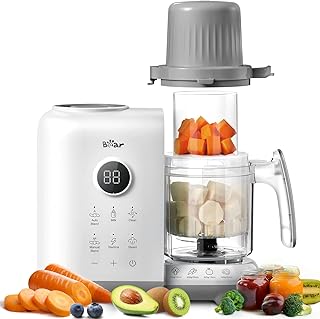
This Grownsy earns a 4.6 rating on the strength of its elevated steam basket, which keeps vegetables above the water line so they steam rather than boil. That single design choice preserves more color and texture in produce like broccoli and carrots. It handles starting-solids purees and transitions well for BLW families who want steamed soft-finger foods without a separate steamer. Cleanup is straightforward with fewer parts than expected. The main drawback is capacity: large batches require two runs, which adds time during weekly prep sessions.
- Pro: Elevated basket steams properly without diluting nutrients into boiling water.
- Pro: Streamlined design keeps the parts count low for easier cleanup.
- Con: Single-batch capacity means multiple cycles for weekly prep.
Skip this if you routinely make large batches for freezer storage and want a single run per session.
Bear Baby Food Maker Steamer & Blender (Dual-Layer)
The Bear dual-layer design lets you steam two different foods simultaneously in its 18.5-ounce capacity, which is a genuine time-saver for parents making varied meals. It also includes a bottle-warming and sterilizing mode, collapsing three appliances into one footprint. At $53.97 with a 4.6 rating, the value proposition is hard to argue with. The dual basket does introduce more parts to wash, and the grinding function works best on softer produce. Tougher items like raw carrot chunks benefit from a brief pre-steam before blending.
- Pro: Dual-layer baskets allow simultaneous steaming of two foods.
- Pro: Built-in sterilize and bottle-warm modes reduce countertop clutter.
- Con: More parts and a learning curve to get the dual basket aligned properly.
Skip this if you want the simplest possible operation with minimal disassembly.
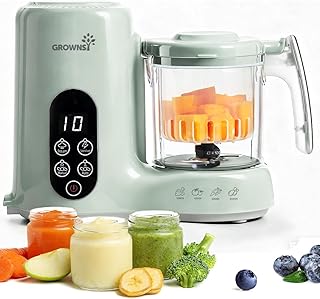
Grownsy Baby Food Maker, Steamer & Blender (Green)
Identical to the White model in every functional respect: same elevated basket, same 4.6 rating, same $69.99 price. The Green colorway exists for buyers who prefer it aesthetically or want to visually distinguish their baby-food station from other white kitchen appliances. Performance, capacity, and cleanup are unchanged. If color matters to you, pick this one without compromise. If it does not, the White model is functionally the same product.
- Pro: Same elevated steam basket and blend quality as the top-scoring White variant.
- Pro: Distinct color helps with kitchen organization if you have multiple appliances.
- Con: Same single-batch capacity limitation as the White model.
Skip this if you already own the White version, since the only difference is exterior color.
Momcozy AutoMeal Baby Food Maker
The Momcozy AutoMeal is the most automated option here at $99.99 with a 4.2 rating. Its six-blade design and 15-ounce cup blend thoroughly, and the auto three-stage texture settings genuinely reduce guesswork for parents new to homemade baby food. Self-cleaning is a real convenience, though it still leaves minor residue on the blade housing that needs a quick rinse. The automation comes at a cost: you get less manual control over exact texture, and the unit is heavier and more complex to operate than simpler models.
- Pro: Three-stage texture presets make stage progression effortless for first-time parents.
- Pro: Self-cleaning cycle handles most residue without disassembly.
- Con: Higher price and reduced manual control for users who want precise consistency.
Skip this if you prefer hands-on control over blending duration and texture.
BEAR Baby Food Maker with Smart Touchscreen
The BEAR Smart Touchscreen at $84.99 with a 4.3 rating adds an LED display and auto-cooking programs to the standard steam-and-blend formula. The touchscreen makes program selection intuitive, and self-cleaning works adequately for soft foods. Where it falls short is on denser produce: the auto-cook timer does not always add enough steam time for root vegetables, requiring manual intervention. It is a solid middle-ground option for parents who want a modern interface without spending over $100.
- Pro: Smart touchscreen with LED display makes program selection clear at a glance.
- Pro: Auto-cooking handles timing without constant supervision.
- Con: Default cook times are too short for dense root vegetables like parsnips.
Skip this if you mainly cook hard root vegetables and do not want to adjust times manually.
Green Sprouts Fresh Baby Food Mill
The Green Sprouts Mill is a manual puree maker that requires no electricity, no batteries, and almost no cleanup beyond a rinse. At $24.99 with a 4.1 rating, it is the cheapest option here and the best for travel, grandparents, or parents who already have a steamer elsewhere. It grinds cooked soft produce through a built-in strainer that separates seeds and skins automatically. The limitation is that it cannot handle fibrous vegetables like celery or kale stems without pre-mashing, and it requires you to steam separately.
- Pro: No electricity, no parts to assemble, trivial cleanup.
- Pro: Built-in strainer removes seeds and skins in one pass.
- Con: Cannot steam or blend; requires a separate cooking step.
Skip this if you want a single appliance that handles both steaming and blending in one cycle.
NutriBullet Baby Complete Food-Making System
The NutriBaby system at $49.99 with a 4.6 rating stands out for its 32-ounce capacity, the largest in this roundup, making it ideal for batch-prepping and freezer storage. The blend quality is excellent for smooth purees, and the NutriBullet motor is among the more powerful in this price range. However, it functions primarily as a blender with a steamer attachment that is less refined than dedicated steam baskets on other models. Vegetables steam unevenly in the tall container, so some pieces soften before others.
- Pro: 32-ounce capacity is the largest here, ideal for weekly batch prep.
- Pro: Powerful motor handles smooth purees without straining.
- Con: Steaming is less even than dedicated elevated-basket designs.
Skip this if consistent steaming matters more to you than large-volume blending.
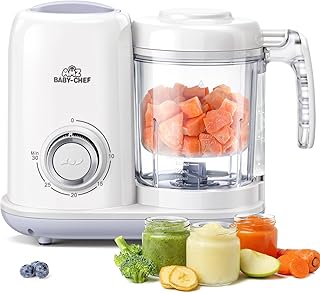
AMZBabyChef 4-in-1 Steamer and Puree Processor
The AMZBabyChef at $41.39 with a 4.6 rating delivers all-in-one steam-and-blend functionality in a Tritan container, which is durable and BPA-free. It suits starting-solids parents who want a compact unit without spending over $50. The four-in-one claim covers steam, blend, puree, and a basic warming mode. Build quality is good but not premium: the blade housing shows wear faster than the stainless-steel alternatives, and the lid seal loosens with heavy use. For the price, it is difficult to beat as a first baby food maker.
- Pro: Tritan construction is shatter-resistant and BPA-free at a budget price.
- Pro: Compact footprint suits small kitchens or travel storage.
- Con: Lid seal degrades with frequent use, affecting steam pressure.
Skip this if you plan to use it daily for more than a few months and want long-term durability.
Buying Guide
Elevated vs. Submerged Steam Baskets
The single most important design feature in any steamer blender is whether the food sits above or in the water. Elevated baskets steam produce with circulating vapor, preserving color, texture, and water-soluble vitamins. Submerged designs boil vegetables, which softens them faster but leaches nutrients into water you may or may not add to the blend. If the product does not explicitly state an elevated or raised basket, assume submersion and prioritize other options. The Grownsy and Bear models in this list use elevated designs; most budget options do not.
Texture Control and Stage Progression
Baby food changes dramatically from six months to twelve months: early purees should be nearly liquid with no lumps, while later stages require thick, textured spoon foods or soft finger pieces. A good machine offers at least two distinct texture options or lets you control blend duration in short pulses. Single-setting blenders that only produce smooth purees force you to stir in oatmeal or breast milk to thicken, which adds steps. Self-cleaning programs are nice but do not substitute for texture control when deciding what to buy.
Cleanup Parts Count and Material Safety
Count how many separate pieces need washing after one use. A unit with a steam basket, blending blade, housing, lid, and gasket has five parts minimum, and some designs have more. If a machine requires soaking or a brush to reach the blade seal, you will resent it after the third week of daily use. Tritan and BPA-free plastics are standard now, but glass or stainless-steel components resist staining and odor retention better over time, especially with strongly pigmented foods like beets and carrots.
Our Verdict
Our top pick is the Grownsy Baby Food Maker in White or Green: the elevated basket solves the steaming problem cleanly, the parts count stays low, and the 4.6 rating reflects consistent real-world performance. For budget buyers, the AMZBabyChef at $41.39 is the best value in this group, offering all-in-one functionality in a durable Tritan shell that costs less than a specialty blender. If your priority is maximum batch capacity for freezer prep, the NutriBullet Baby system wins despite its weaker steaming, because its 32-ounce volume halves the number of cycles you need to run.
FAQ
Are baby food makers worth it over a regular blender?
Yes, if you steam and blend weekly. A regular blender cannot steam, so you would need a separate steamer, a transfer step while produce is hot, and additional cleanup. The time savings and temperature control in a dedicated unit justify the cost for most families making food at home more than twice per week.
Can I use a baby food maker for toddler meals?
You can, but texture options become limiting once your child moves past purees. Toddler meals benefit from chunks and varied consistencies that these machines were not designed to produce. A baby food maker works best as a primary tool from six months through about twelve months, then serves a secondary role for soups and soft sauces.
How often do I need to replace the blade or container?
Stainless-steel blades in quality units should last the product lifetime without replacement. Tritan and plastic containers develop micro-scratches over months of hot steam exposure, which can harbor odor and stain. If you notice persistent smells or cloudiness after washing, replace the container or upgrade the unit rather than risking bacterial buildup.
Is self-cleaning actually effective or a gimmick?
Self-cleaning handles soft-food residue well but struggles with starch-heavy foods like sweet potato and banana that dry onto blade housing. Treat it as a first-pass rinse rather than a full wash: run the cycle, then wipe the blade seal and under-lid crevices with a damp cloth. It saves time but does not eliminate cleanup entirely.