Key takeaways
- Use the bassinet only for sleep if its manufacturer identifies it as an infant sleep product, and follow the current instructions and warnings.
- Place baby on their back on the original, firm, flat mattress with only the fitted sheet designed for that model. Keep pillows, blankets, positioners, toys, and other soft items out of the sleep space.
- Use the product’s stationary or locked setting for sleep when required by its manual. Never leave a moving bassinet unattended unless the manufacturer explicitly permits that mode for sleep.
- Stop using the bassinet when the baby reaches its stated weight limit or can push up on hands and knees, roll, or otherwise reaches the model’s stated outgrown criteria—whichever comes first.
- For a bedside model, follow its instructions for distance, height, attachment, and side-panel position. Do not assume it can be used as an open-sided sleep space unless the manual allows it.
The best rocking bassinets by use case
The best rocking bassinets are the ones that match your space and routine without compromising a firm, flat, empty sleep surface: choose a manual rocker for simple, cordless motion, or a powered model if you want adjustable movement and built-in controls. For a small room, compare the whole bedside footprint—not just the mattress—and check whether the unit can be locked still for sleep.
Manual versus powered: what changes in daily use?
A manual rocking bassinet moves when a caregiver gently nudges it. Its mechanism is typically a curved base, pivoting frame, or gliding stand. It needs no power, has fewer electronic parts to maintain, and may be easier to move between rooms. The trade-off is that the motion is caregiver-controlled rather than timed or adjustable.

GROWNSY 5-in-1 Baby Bassinet Bedside Sleeper with Gentle Manual Rocking
Included for 'Best Rocking Bassinets: Gentle Motion and Practical Features Compared' as a relevant option in this category; details come from the product listing.
View on Amazon
Ezebaby Baby Bassinet Bedside Sleeper: 3-in-1 Rocking Bassinet for Baby - Breathable Full-Mesh Crib with Mattress | 6 Height Adjustable | Portable Crib with Lockable Wheels for Newborns
Included for 'Best Rocking Bassinets: Gentle Motion and Practical Features Compared' because the listing specifies Breathable Full-Mesh Crib with Mattress and 6 Height Adjustable, details this guide uses to compare options.
View on Amazon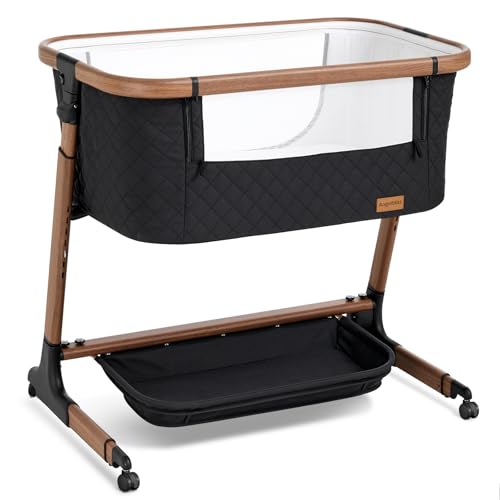
ANGELBLISS Electric Baby Bassinet, Auto Rocking Bedside Sleeper, 6 Heights with Mattress, Washable Sheet, Remote Control, 5 Speeds, 3 Timers, 12 Sounds, Wheels & Storage, Black
Included for 'Best Rocking Bassinets: Gentle Motion and Practical Features Compared' because the listing specifies Auto Rocking Bedside Sleeper and 6 Heights with Mattress, details this guide uses to compare options.
View on Amazon
Graco SmartSense Soothing Baby Bassinet
Included for 'Best Rocking Bassinets: Gentle Motion and Practical Features Compared' as a relevant option in this category; details come from the product listing.
View on AmazonA powered model uses a motor to create a defined rocking, swaying, or gliding motion. Depending on the model, it may offer motion settings, a timer, or sound controls. It needs power or charged batteries, and the motor, controls, or fabric assembly add parts to keep clean and in working order. Powered motion is not a substitute for supervision or a safe sleep surface.
“Rocking” can describe different motions. Side-to-side sway, front-to-back gliding, and a cradle-like pivot are not interchangeable, so look for a product demonstration or clear manufacturer description before buying. Avoid improvising movement by placing a stationary bassinet on a rocking base it was not designed to fit.
Compare dimensions and practical features
Exact dimensions and weight limits vary by model and configuration. The table below uses published manufacturer specifications for representative products; verify the current manual and product listing before purchase, particularly for mattress dimensions, approved accessories, and maximum weight.
| Product | Motion | Published footprint or dimensions | Sleep-area dimensions | Weight limit | Portability and power |
|---|---|---|---|---|---|
| HALO BassiNest Swivel Sleeper 3.0 | Manual lowering side wall; not a powered rocker | Base footprint about 34 × 34 in | About 32 × 18 in | 20 lb | Swivels over a bedside base; no motor |
| Fisher-Price Soothing Motions Bassinet | Manual rocking motion | About 36 × 22 × 28 in | About 30 × 18 in | 20 lb | Designed to rock by hand; some versions include battery-powered soothing features |
| Graco Sense2Snooze Bassinet | Powered rocking and soothing features | About 35 × 24 × 34 in | About 30 × 18 in | 20 lb | Powered; not as compact as a simple travel bassinet |
| 4moms mamaRoo Sleep Bassinet | Powered, adjustable motion | About 36 × 24 × 34 in | About 30 × 18 in | 25 lb | Powered; larger stationary footprint |
Dimensions above are approximate and may describe different points on the frame; they are not a promise that a unit will fit a particular bedside gap. The sleep-area measurements are included for comparison, not to suggest that a replacement mattress or pad is suitable. Use only the mattress and bedding specified by the manufacturer.
Choose by room, routine, and budget
| Your situation | What to prioritize | Likely fit |
|---|---|---|
| Very limited bedroom space | Base width and length, clearance for rocking or swiveling, and access to drawers or walkways | A compact manual model, if its full base fits; measure first |
| You want no electronics | Stable frame, simple lock or stationary mode, removable washable fabric | Manual rocker or glider |
| You use soothing features frequently | Motion options, controls that are easy to reach, power arrangement, and a clear stationary mode | Powered bassinet, provided its footprint works |
| You move the sleep space between rooms | Frame weight, folding or disassembly, carry handles, and whether the mattress stores separately | A lighter manual model; confirm that it is designed for repeated relocation |
| You need a bedside approach | Leg placement, height adjustment, clearance under the bed, and the manufacturer’s rules for bedside use | A purpose-built bedside model such as the HALO BassiNest; follow its setup instructions |
Prices vary by retailer, configuration, and sale. As a broad market guide, basic manual bassinets often fall around $50–$150, while powered models commonly cost roughly $150–$400 or more. A higher price may buy controls or convenience features, but it does not make a product safer or guarantee that a baby will settle in it.
Measure the bedside footprint before ordering
Measure the floor area the frame and base will occupy, then add clearance for the motion. For a powered bassinet, include space for the cord and access to its controls. For a swivel model, check that the sleep area can move over the bed as intended without hitting a wall or furniture. Measure the bed’s height and any under-bed obstruction too; a bedside unit may have legs that need to slide beneath the frame.
For example, a bassinet with a 24-inch-wide base does not necessarily fit a 24-inch gap: the frame may need extra room to rock, and the widest point may be elsewhere. Leave enough space to reach the baby and to walk safely around the unit. If the room is tight, a stationary setting may help, but it does not reduce the physical footprint.
Safe-sleep checks that matter more than motion
- Use the bassinet only for sleep if its manufacturer identifies it as an infant sleep product, and follow the current instructions and warnings.
- Place baby on their back on the original, firm, flat mattress with only the fitted sheet designed for that model. Keep pillows, blankets, positioners, toys, and other soft items out of the sleep space.
- Use the product’s stationary or locked setting for sleep when required by its manual. Never leave a moving bassinet unattended unless the manufacturer explicitly permits that mode for sleep.
- Stop using the bassinet when the baby reaches its stated weight limit or can push up on hands and knees, roll, or otherwise reaches the model’s stated outgrown criteria—whichever comes first.
- For a bedside model, follow its instructions for distance, height, attachment, and side-panel position. Do not assume it can be used as an open-sided sleep space unless the manual allows it.
Safe-sleep guidance and product standards can change. Consult the current manufacturer’s manual and applicable public-health guidance. If you are unsure whether a particular setup is appropriate, ask your pediatrician or another qualified professional.
Ownership: cleaning, wear, and common mistakes
Fabric panels and fitted sheets usually need the most frequent attention. Check whether the cover is removable and machine washable, and whether the manual permits spot-cleaning or specifies a mild detergent. Do not soak a motor, control unit, or electrical connection. Keep liquids away from powered components and let washed fabric dry fully before reassembly.
With manual designs, inspect the rocking feet, joints, and locking parts for looseness or damage. With powered designs, keep the power supply and cord in the arrangement specified by the manufacturer, and stop using the unit if a control or motion behaves unexpectedly. Batteries, if used, are a recurring cost; motors and electronics add potential repair or replacement considerations compared with a basic frame.
Common buying mistakes include measuring only the mattress, assuming all “rocking” motion is the same, adding an unapproved mattress topper, and treating a soothing feature as a reason to leave a baby unattended. Before buying secondhand, check the exact model against current recalls and make sure every required part—including the correct mattress and hardware—is present.
For a compact, low-complexity choice, start with a manual rocker and compare its locked mode and full base dimensions. If adjustable motion is a priority and you have room and reliable power, compare powered models by their motion controls and cleaning requirements. In either case, the deciding factor should be a properly sized, firm, flat sleep surface and a setup that follows the product’s current instructions.