Our Top Picks
 Munchkin® STEP™ Diaper Pail Powered by Arm &5 Piece Set12.4 x 11.5 x 27.5 inches11.3 PoundsCheck on Amazon
The best diaper pails for most families are the Ubbi Steel for the lowest long-term refill cost, the Munchkin Step for strong odor control with a foot pedal, and the Diaper Genie Complete for a compact, convenient all-rounder.
The right choice depends less on the advertised diaper capacity than on four ownership details: whether the lid seals between changes, how much each refill costs, whether you can operate it with one hand, and whether its footprint works beside your changing table. No diaper pail eliminates odor completely; the goal is to contain it until the pail is emptied.
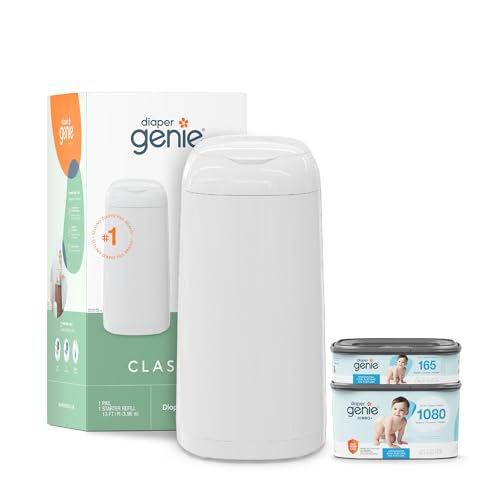
Diaper Genie Classic Diaper Pail Gift Set | Push-N-Lock Odor Control | Includes Starter Refill and Jumbo+ Refill | Holds up to 1,245 Newborn Diapers | Baby Registry Must-Have
Chosen because it specifies Push-N-Lock Odor Control and Includes Starter Refill and Jumbo+ Refill.
View on AmazonMunchkin® STEP™ Diaper Pail Powered by Arm & Hammer, #1 in Odor Control, Award-Winning, Includes 1 Snap, Seal & Toss™ Bag, 1 Starter Refill Ring, and 1 PUCK™ Baking Soda Cartridge
Chosen because it specifies #1 in Odor Control and Award-Winning.
View on Amazon
Ubbi Stainless Steel Diaper Pail, No Special Bags, Odor-Locking, White
Chosen because it specifies No Special Bags and Odor-Locking.
View on Amazon
Momcozy Triple-Seal Diaper Pail with Odor Locking, Ergonomic Height Design
Chosen because it specifies Ergonomic Height Design.
View on AmazonBest diaper pails by situation
| Situation | Best fit | Why it makes sense | Main compromise |
|---|---|---|---|
| Lowest ongoing cost | Ubbi Steel | Uses ordinary 13-gallon kitchen bags or reusable cloth liners | Requires a hand-operated sliding lid |
| Strong odor containment | Munchkin Step | Twist-sealing refill and foot pedal reduce contact with the pail | Proprietary bags cost more |
| Small changing-table area | Diaper Genie Complete | Relatively narrow footprint and hands-free pedal opening | Refills are a continuing expense |
| Frequent diaper changes | Dekor Plus | Large opening and high stated capacity reduce emptying frequency | Taller body needs clearance and stable placement |
| Simple, contained disposal | Tommee Tippee Twist & Click | Each diaper is individually twisted into a multilayer refill | Its refill system is less economical than standard bags |
Head-to-head: the leading diaper-pail designs
Ubbi Steel: best for refill savings
The Ubbi Steel is the clearest choice if you dislike the idea of buying a proprietary refill every few weeks. Its powder-coated steel body uses rubber seals around the sliding lid, and it accepts standard 13-gallon bags. The manufacturer lists an approximately 11-gallon capacity and dimensions of about 19 by 12 by 24 inches, though small variations can occur by color and market.
Steel is less porous than many plastic bodies, but the lid seal and bag-fitting routine matter more than the material alone. Slide the lid open only as far as needed, drop the diaper in, and close it promptly. The Ubbi is not foot-operated, so it is less convenient when one hand is holding a baby. Its opening can also be awkward for oversized overnight diapers.
Its ownership advantage is substantial. If a standard bag costs roughly $0.20 to $0.40 and holds 25 to 35 diapers, the bag cost is approximately $0.01 to $0.02 per diaper. Proprietary refill systems commonly land closer to $0.03 to $0.08 per diaper, depending on the pack and actual fill level.
Munchkin Step: best for hands-free use and odor control
The Munchkin Step combines a foot pedal, a self-sealing door, and a ring that twists the refill as the lid closes. The manufacturer describes a capacity of up to 272 newborn-size diapers, but real capacity is lower with larger diapers or when you empty the pail before it becomes tightly packed. Its approximate footprint is 12 by 27 inches, with a height near 27 inches depending on the configuration.
The pedal is helpful during rapid changes: step, drop, release, and continue dressing the baby. The system also uses a baking-soda cartridge intended to help control odor. That cartridge is a consumable, so include it in the running cost rather than treating it as a one-time feature.
The trade-off is the refill. Munchkin-compatible bags are convenient and effective at separating odor between sections, but the cost per diaper is higher than using ordinary trash bags. The twisting mechanism also works best when the bag is not overfilled. Waiting until the pail is packed can make the final section difficult to tie and remove.
Diaper Genie Complete: best compact convenience
The Diaper Genie Complete has a foot pedal, a built-in antimicrobial treatment in the plastic system, and a multilayer refill designed to help contain odor. Published dimensions are approximately 12 by 12 by 28 inches, making it one of the easier options to position near a changing table without using much floor space.
Its stated capacity is commonly around 270 newborn-size diapers. As with every pail, that number is a planning figure rather than a guarantee: size 4 diapers occupy more space, and cloth or heavily wet diapers should not be compressed indefinitely. The narrower body can also feel top-heavy if placed where a toddler can pull on it.
The Complete is a good fit for caregivers who value one-handed or foot-operated use and do not mind buying matching refills. Before choosing it, measure the space with the pedal fully accessible. A pail that fits behind a door but cannot be opened without moving the changing table is not practically compact.
Dekor Plus: best for a high-volume nursery
The Dekor Plus is a tall, plastic, step-operated pail with a wide opening and a hands-free disposal method. It is designed for high capacity, with manufacturer figures commonly reaching approximately 580 newborn-size diapers. Its body is roughly 21 to 22 inches tall before considering the lid and pedal area, and its broad base needs more floor space than a narrow cylindrical pail.
The continuous refill allows you to cut and tie the bag at any point instead of waiting for a fixed cartridge section. That can reduce waste if you empty the pail frequently or use it in a nursery with several children. It also makes the system easier to adapt to your changing routine.
Its weakness is not odor technology but volume and placement. A large, nearly full pail can be cumbersome to carry, and a tall unit may not fit under a low shelf. The foot pedal and cutting mechanism are parts to inspect over time; forced lids, overloaded bags, and misaligned refill film are common causes of frustrating operation.
Tommee Tippee Twist & Click: best for individually wrapped disposal
The Tommee Tippee Twist & Click system wraps each diaper in the refill film as it enters the pail. That design puts more material between the diaper and the room air than a basic bag-lined bin, which can be useful in a small nursery or apartment.
The pail is generally compact, but its capacity is lower than the largest high-volume models because each diaper is individually twisted. It also depends on proprietary refills, so the purchase price of the container understates the total cost of ownership. The twisting action is most effective when the diaper is rolled tightly and pushed fully through the opening.
Comparison of measurable trade-offs
| Model or design | Approximate capacity | Approximate footprint | Operation | Refill approach |
|---|---|---|---|---|
| Ubbi Steel | 11 gallons; about 50 newborn diapers per bag change | 19 × 12 inches; about 24 inches high | Sliding hand lid | Standard 13-gallon bags or cloth liner |
| Munchkin Step | Up to about 272 newborn diapers | About 12 × 12 inches; about 27 inches high | Foot pedal and twist-sealing door | Proprietary continuous refill |
| Diaper Genie Complete | Up to about 270 newborn diapers | About 12 × 12 inches; about 28 inches high | Foot pedal | Proprietary multilayer refill |
| Dekor Plus | Up to about 580 newborn diapers | About 13 × 14 inches; about 22 inches high | Foot pedal and continuous bag | Proprietary continuous refill |
| Twist-and-seal design | Typically 20–40 diapers per refill section | Usually 10–14 inches wide | Hand press or twist mechanism | Individually twisted proprietary film |
Capacity figures are based on newborn-size diapers and are useful mainly for comparing models. A larger diaper can consume two or more times the volume of a newborn diaper, while frequent emptying improves odor control but lowers the number of diapers per bag.
What refills really cost
Use this calculation before buying. Suppose your baby uses 10 diapers per day and a refill section holds 25 diapers. You will use about 12 sections per month. At $6 to $12 per section, that is approximately $72 to $144 per year. A standard trash bag system might cost roughly $0.20 to $0.40 per bag and hold 25 to 35 diapers, producing an annual bag cost closer to $25 to $58.
Those are market-range estimates, not fixed prices. Local refill packs, sales, diaper size, and how tightly you fill the pail can change the result. Add replacement odor cartridges where applicable, and do not assume that a larger advertised capacity automatically means lower cost.
Setup and maintenance that make a bigger difference than marketing
- Measure the available space, including the pedal swing, lid clearance, and room to pull out a full bag.
- Install the refill without twisting or pinching the film. A misaligned cartridge can leave gaps or prevent the cutting mechanism from working.
- Roll disposable diapers tightly and fasten tabs before disposal. This saves space and limits the exposed surface.
- Empty the pail before it is completely full, especially in hot weather or when it contains several overnight diapers.
- Wipe the lid, opening, pedal, and sealing surfaces weekly with mild soap and water, then dry them thoroughly.
- Replace worn seals, refill cutters, or odor cartridges according to the manufacturer’s instructions rather than forcing a jammed mechanism.
Do not put loose wipes, bottles, or household trash into a diaper pail unless its instructions permit them. Extra contents consume capacity and can obstruct the seal. Avoid spraying fragrance directly into the pail; residue can collect on rubber seals and plastic hinges.
Bottom line
Choose the Ubbi Steel if refill flexibility and long-term cost matter most. Choose the Munchkin Step if odor containment and a foot pedal justify proprietary refills. Choose the Diaper Genie Complete when a compact, familiar hands-free design is the priority. Choose the Dekor Plus for a high-volume nursery with enough floor space, and the Tommee Tippee Twist & Click when individually wrapped disposal is worth the added refill cost.