Key takeaways
- Allergies: Read the current ingredient and allergen statement for every meal. Do not rely only on a kit’s general “allergy-friendly” description.
- Vegetarian or vegan diets: Choose a kit whose individual meals meet your requirements; many mixed kits contain dairy, egg, or meat-based ingredients.
- Gluten-free diets: Look for explicit labeling and check shared-equipment warnings.
- Children: Include familiar foods, softer textures, and snacks. Spicy meals and unfamiliar beans may not be accepted during a stressful outage.
- Low-sodium needs: Emergency meals can be salty. Anyone managing a medical condition should select foods with professional dietary guidance.
- Infants: Infant formula and feeding water require their own plan. Do not substitute emergency meal products for an infant’s usual nutrition.
The best emergency food kits for most households are shelf-stable, water-efficient kits with at least 2,000 calories per adult per day, a clearly stated serving count, and enough variety that your family will actually eat them; Mountain House is a strong freeze-dried choice, Augason Farms suits larger pantry-style supplies, and ReadyWise is convenient for mixed family meals.
Quick picks by household situation
| Household need | Best fit | Why | Main compromise |
|---|---|---|---|
| Small, portable emergency reserve | Freeze-dried meal kit | Lightweight, long shelf life, simple preparation | Requires drinking water and usually provides less food variety |
| Lowest cost per calorie | Bulk pantry kit with grains, beans, milk, and baking ingredients | Typically more calories for the money | Needs more cooking fuel, water, equipment, and skill |
| Family with children | Mixed meal kit plus familiar snacks | More approachable flavors and textures | Individual pouches can cost more and create more packaging waste |
| Apartment or small storage area | Compact freeze-dried bucket | Good shelf life per cubic foot and no refrigeration | Serving labels may overstate practical household coverage |
| Long power outage with limited fuel | Ready-to-eat canned and packaged foods | Can be eaten without boiling water | Heavier, shorter-lived, and often less calorie-dense |
Best emergency food kits compared
Mountain House: best for lightweight, dependable freeze-dried meals
Mountain House is a well-established freeze-dried food brand with entrees, breakfast foods, desserts, and larger emergency supplies. Its pouches are useful when storage space, transport weight, or preparation simplicity matters. Many products have shelf lives measured in decades when unopened and stored in a cool, dry place, but the exact date depends on the product and packaging.

Ready Hour 120 Serving Entree Bucket-Freeze Dried Emergency Food Supply-Survival Meals with Long Shelf Life-Prepper Essentials for Disaster, Camping, Hiking, or Outdoor Use
Included for 'Best Emergency Food Kits for Home Preparedness' because the listing specifies Camping and Hiking, details this guide uses to compare options.
View on Amazon
READYWISE Emergency Food Supply Survival Bucket, 132 Servings
Included for 'Best Emergency Food Kits for Home Preparedness' because the listing specifies 132 Servings, details this guide uses to compare options.
View on Amazon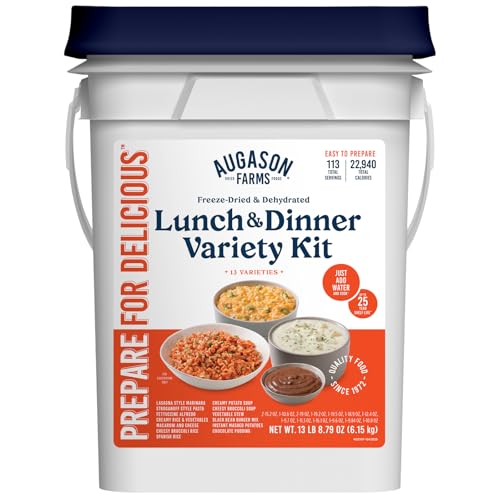
Augason Farms Lunch & Dinner Variety Kit 4 Gallon Bucket
Included for 'Best Emergency Food Kits for Home Preparedness' as a relevant option in this category; details come from the product listing.
View on Amazon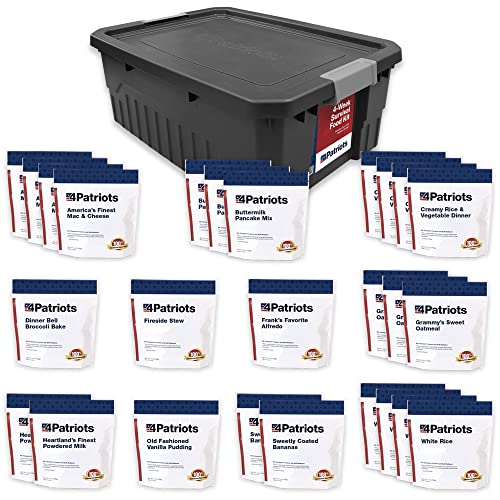
4Patriots 4-Week Survival Food Kit: Emergency Food Supply Designed to Last 25 Years, 192 Servings
Included for 'Best Emergency Food Kits for Home Preparedness' because the listing specifies 192 Servings, details this guide uses to compare options.
View on AmazonThe practical advantage is meal format: add the specified amount of hot water, close the pouch, wait, and eat. That is easier than turning dry wheat, beans, or powdered ingredients into meals. The limitations are price and water dependence. A pouch described as two servings may be a light meal for two adults rather than a substantial dinner, so compare total calories rather than serving count alone.
Augason Farms: best for building a larger pantry reserve
Augason Farms offers both meal-style products and bulk ingredients such as freeze-dried vegetables, potatoes, milk, oats, beans, and wheat. This makes it a better fit for households that want flexibility rather than a stack of identical entrees. Bulk ingredients can stretch ordinary pantry cooking and may offer a lower cost per calorie.
The trade-off is preparation. Some products require simmering, soaking, grinding, or combining with other ingredients. A bucket can claim dozens or hundreds of servings while supplying relatively few complete meals. Before buying, check whether the container is primarily ingredients, whether it includes protein, and how much water and fuel are needed.
ReadyWise: best for convenient mixed-meal kits
ReadyWise sells emergency meal kits containing items such as pasta dishes, rice-based meals, soups, and breakfast foods. These kits are designed for straightforward preparation and can be convenient for households that do not want to plan a menu from separate ingredients.
Check the nutrition panel carefully. Some kits advertise a high serving count but distribute calories across many small servings. A useful comparison is total calories divided by the number of days and people you intend to cover. Also verify whether the kit’s stated shelf life applies to the sealed outer container or to every individual pouch after opening.
4Patriots: best considered as part of a broader reserve
4Patriots sells long-term food kits and individual shelf-stable items, often organized around multi-day or larger household supplies. These can be convenient for shoppers who want a packaged plan, but the same label-reading rules apply: count calories, inspect protein amounts, calculate water needs, and distinguish servings from complete daily rations.
A packaged kit should not be your only emergency food. Add foods that need no preparation, especially if you may lose water, fuel, or cooking equipment at the same time.
How many days does a kit really cover?
Use calories, not the marketing phrase “three-day supply,” to estimate coverage. For planning purposes, a moderately active adult may need roughly 1,800 to 2,400 calories per day, while children’s needs vary substantially with age and size. This is a planning estimate, not individualized nutrition advice.
For example, suppose a kit contains 18,000 total calories. For two adults and one school-age child, using a planning target of 2,000 calories per adult and 1,500 for the child, the calculation is:
18,000 calories ÷ (2,000 + 2,000 + 1,500) = about 3.3 days.
If the same kit claims 120 servings, that equals 150 calories per serving on average. It may still be useful, but it is not 120 adult meals. Treat servings as portions and calories as the coverage measure.
| Planning example | Daily calories used | Calories for 3 days | Calories for 7 days |
|---|---|---|---|
| One adult | 2,000 | 6,000 | 14,000 |
| Two adults | 4,000 | 12,000 | 28,000 |
| Two adults and one child | 5,500 | 16,500 | 38,500 |
| Two adults and two children | 7,000 | 21,000 | 49,000 |
Water, fuel, and packaging matter as much as food
Freeze-dried meals often require approximately 1 to 2 cups of water per pouch, although the label is the authority. A 12-pouch daily supply could therefore require 12 to 24 cups—roughly 0.75 to 1.5 gallons—for rehydration alone. Add drinking, sanitation, pets, and infant needs separately. If your emergency plan assumes tap water will remain available, store the required water as well.
Most freeze-dried products come in foil laminate pouches, cans, or sealed plastic buckets. Foil pouches are light and convenient but can be punctured. Cans protect contents well but add weight and may be difficult to inspect after damage. Buckets help organize storage, yet the bucket itself does not make a poor storage location safe: avoid garages, attics, and sheds with large temperature swings.
Dietary and family considerations
- Allergies: Read the current ingredient and allergen statement for every meal. Do not rely only on a kit’s general “allergy-friendly” description.
- Vegetarian or vegan diets: Choose a kit whose individual meals meet your requirements; many mixed kits contain dairy, egg, or meat-based ingredients.
- Gluten-free diets: Look for explicit labeling and check shared-equipment warnings.
- Children: Include familiar foods, softer textures, and snacks. Spicy meals and unfamiliar beans may not be accepted during a stressful outage.
- Low-sodium needs: Emergency meals can be salty. Anyone managing a medical condition should select foods with professional dietary guidance.
- Infants: Infant formula and feeding water require their own plan. Do not substitute emergency meal products for an infant’s usual nutrition.
What to buy first on different budgets
On a limited budget
Start with three days of water, ready-to-eat foods, canned protein, peanut butter if appropriate, crackers, oats, shelf-stable milk, and familiar snacks. Add a small freeze-dried meal kit later. This approach usually provides more immediately usable calories than spending the entire budget on a container with attractive serving numbers.
With room for a larger reserve
Combine a short-term no-cook supply with a longer-term kit. A practical arrangement is three days of ready-to-eat food, seven to fourteen days of simple rehydratable meals, and bulk ingredients only if you already own the water, stove, pots, can opener, and fuel to use them.
Storage and rotation checklist
- Record the purchase date and best-by date on the outside of each container.
- Store food indoors in a cool, dry, dark location above the floor.
- Keep a manual can opener, measuring cup, pot, stove, fuel, utensils, and water nearby.
- Open one sample meal before relying on the kit. Check taste, texture, portion size, and preparation time.
- Rotate foods into ordinary meals before their dates and replace them with fresh supplies.
- Inspect pouches and cans for swelling, leaks, rust, tears, or broken seals. Discard damaged or suspicious packaging.
The best emergency food kits are not necessarily the ones with the most servings or the longest advertised shelf life. Choose the kit whose calories, water requirements, dietary fit, storage format, and preparation method match your actual household—and then pair it with stored water, fuel, and foods that can be eaten if cooking is impossible.