Our Top Picks


A backyard sandbox gives a baby or toddler a small, contained world to dig in, pour from, and build with, all within a few steps of the back door. Unlike a trip to a playground, a sandbox at home is ready whenever the weather cooperates, and it keeps the mess in one defined spot instead of spread across the lawn. For families with a baby who is just starting to sit and scoop, or a toddler who wants to dig for an hour, the right sandbox is less about size and more about fit: low walls a small child can climb over, a lid that keeps the sand clean, and enough room for a parent to sit nearby.
This guide compares five backyard sandboxes that suit babies and toddlers, from compact plastic animal sandboxes with snap-on lids to large wooden sandboxes with adjustable canopies and foldable bench seats. Every pick below includes a lid or cover, because an uncovered sandbox fills with rain, leaves, and visits from neighborhood animals faster than most families expect. Sand is sold separately for every sandbox on this list, so plan on buying play sand after the box arrives, and always supervise a baby or toddler during sand play.
As an Amazon Associate, we earn from qualifying purchases.
Table of Contents
- Quick Answer
- Little Tikes Turtle Sandbox 2.0
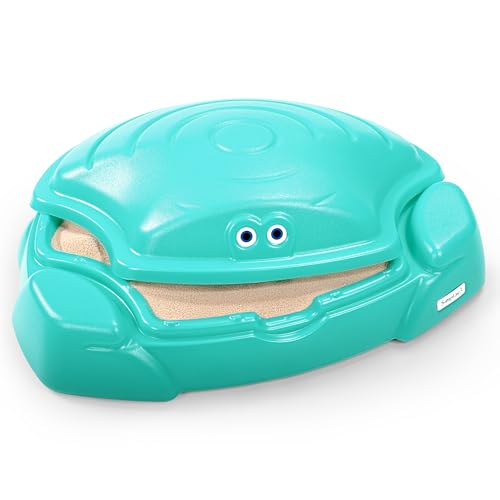
- Simplay3 Coastal Crab Sandbox
- YOLENY Wooden Sandbox with Lid and Canopy
- Outsunny Wooden Sandbox with Canopy
- FunXplore Wooden Sandbox with Picnic Table and Canopy
- How to Choose
- Who Should Skip It
- Frequently Asked Questions
- Conclusion
- Product and ASIN Reference
Quick Answer
For most families, the Little Tikes Turtle Sandbox 2.0 is the simplest starting point: a compact plastic sandbox with a snap-on shell lid and four molded seats for ages 1 to 6. Families who want shade and seating should look at the YOLENY or Outsunny wooden sandboxes with adjustable canopies and foldable benches. All five picks below include a lid or cover.
Little Tikes Turtle Sandbox 2.0

The Little Tikes Turtle Sandbox 2.0 is the classic backyard sandbox, and it earns the top spot here because it is the easiest fit for the youngest players. The turtle shape is low and wide, so a toddler can climb in and out without a step stool, and the four molded seats on the outside rim give small children a place to perch while they dig. The shell lid tethers to the base and snaps closed, which keeps rain and debris out of the sand between play sessions.
Little Tikes lists this sandbox for ages 1 to 6 years, with manufacturer guidance of 12 to 72 months, which gives it one of the widest age windows on this list. A one-year-old can sit inside with a parent close by and pat the sand, while a five-year-old can still fit comfortably and use the rim seats. The plastic body wipes clean after muddy play, and there is no wood to seal, stain, or check for splinters. The maximum weight recommendation is 100 pounds, which is a useful guardrail for families deciding how many children can play at once.
The trade-off is size. This is a compact sandbox, so it suits one or two small children at a time rather than a whole playgroup, and it offers no shade of its own. Families with a sunny yard will want to place it under a tree or a patio umbrella for midday play. For a first sandbox for a baby or young toddler, though, the turtle is hard to beat: simple, sturdy, easy to cover, and sized for small hands and short legs. The turtle shape also helps contain the sand: the raised rim and the enclosed curve keep scooped sand inside the box better than a flat-sided frame, which means less sweeping at the end of the day.
Specs
- Brand: Little Tikes
- Model: 664526-M8
- Age range: 1 to 6 years; manufacturer guidance 12 to 72 months
- Material: Plastic
- Lid: Removable turtle shell lid that tethers and snaps closed
- Seating: Four molded seats on the outside rim
- Maximum weight recommendation: 100 pounds
Simplay3 Coastal Crab Sandbox
The Simplay3 Coastal Crab Sandbox is the other animal-shaped pick on this list, and it is the best choice for the smallest yards and the youngest toddlers. At 33.5 by 26 by 10 inches and 15 pounds, it is the lightest and most compact sandbox here, so it fits on a small patio, a balcony-sized yard, or a corner of the lawn that a larger wooden box would swallow. The fitted cover keeps the sand protected from the elements, which the maker says allows for year-round play.
Simplay3 lists this sandbox for ages 1.5 to 5 years, and the maker notes that it holds up to 100 pounds of play sand, which is generous for its footprint. The body is made from UV-resistant resin, so it is built to sit outside in the sun without fading or going brittle quickly, and there is no assembly required: set it down, add sand, and play can start the same afternoon.
The small size is both the strength and the limit of this pick. One toddler, or two small children sitting close together, will fit comfortably, but three or four children will crowd each other, and an older child near the top of the age range may find the walls low and the digging shallow. For a family with a baby or young toddler and a small outdoor space, however, the Coastal Crab is a smart match: it takes up little room, covers easily, needs no assembly, and holds enough sand for real digging play.
Specs
- Brand: Simplay3
- Dimensions: 33.5 x 26 x 10 inches
- Weight: 15 pounds
- Age range: 1.5 to 5 years
- Material: UV-resistant resin
- Lid: Removable lid that doubles as the crab shell
- Sand capacity: Holds up to 100 pounds of play sand
- Assembly: None required
- Made in: USA
YOLENY Wooden Sandbox with Lid and Canopy
The YOLENY Wooden Sandbox with Lid and Canopy is the pick for families who want a full backyard setup: shade, seating, and a real lid in one box. The wooden frame measures 43.7 by 43.7 by 43.3 inches, which gives several children room to dig at once without elbowing each other, and the two foldable bench seats mean children can sit at the edge with their legs in the sand instead of kneeling on the grass. When play is over, the benches fold down to form part of the cover, so the sandbox closes up neatly instead of leaving loose boards leaning against a fence.
The adjustable UV-resistant roof is the feature that sets this sandbox apart from the plastic picks above. It tilts to follow the sun through the afternoon, so a toddler can keep playing in shade while a parent watches from a nearby chair. That matters more than it sounds: a sandbox in full sun heats up fast, and hot sand is the quickest way to end a play session early. YOLENY lists this sandbox for ages 2 to 8 years, and the maximum weight recommendation of 250 pounds covers several children plus the occasional parent who sits on the bench to join in.
The size and weight are the costs of all that capacity. At 47.8 pounds, this is a two-person job to move and assemble, and it needs a flat patch of yard roughly four feet square, plus clearance around it for the benches and the roof. The benches are wide enough for a toddler to sit with legs stretched into the sand, and the frame sits low enough that a small child can climb in from the side without help. For a family with a yard to spare and two or more children who will use the sandbox for years, the YOLENY is the most complete setup on this list.
Specs
- Brand: YOLENY
- Dimensions: 43.7 x 43.7 x 43.3 inches
- Weight: 47.8 pounds
- Age range: 2 to 8 years
- Material: Wood
- Lid: Wooden lid with waterproof top; bench seats fold down to form the cover
- Canopy: Adjustable UV-resistant roof
- Seating: Two foldable bench seats
- Bottom liner: Included
- Maximum weight recommendation: 250 pounds
Outsunny Wooden Sandbox with Canopy
The Outsunny Wooden Sandbox with Canopy is the middle ground between the compact plastic sandboxes and the larger YOLENY: a wooden box with shade and seating, in a lighter frame that is easier to place. It measures 41.7 by 41.7 by 45.3 inches and weighs 32.2 pounds, so it offers nearly the same footprint as the YOLENY while being noticeably lighter to move and assemble. The canopy shades the play area from above, the foldable bench seats give children a place to sit while they dig, and a bottom liner is included to keep sand in and weeds out.
Outsunny lists this sandbox for ages 3 to 7 years, with manufacturer guidance of 36 months to 7 years, which makes it a better fit for a toddler who is already steady on their feet than for a baby who is still sitting and scooping. For a family that wants the wooden sandbox look and a shaded play space, but does not need the largest box on the list, the Outsunny hits a practical balance of size, shade, and seating.
One thing to weigh before buying is the age range: it starts at three years, so a family buying for a one-year-old should wait or choose one of the plastic picks above and move up to a wooden box later. Kept covered when not in use, the Outsunny gives a growing toddler a shaded, seated place to dig for several summers.
Specs
- Brand: Outsunny
- Model: 343-029V00LR
- Dimensions: 41.7 x 41.7 x 45.3 inches
- Weight: 32.2 pounds
- Age range: 3 to 7 years; manufacturer guidance 36 months to 7 years
- Material: Wood
- Lid: Cover included
- Canopy: Included
- Seating: Foldable bench seats
- Bottom liner: Included
FunXplore Wooden Sandbox with Picnic Table and Canopy
The FunXplore Wooden Sandbox with Picnic Table and Canopy is the most versatile pick on this list, because it changes shape with the moment. Open, it is a sandbox with a lid, an adjustable canopy, and a bottom liner for backyard play. Folded, the wooden cover becomes a picnic table, so the same footprint serves lunch, snacks, coloring, and craft time when the sand is put away. The sandbox measures 42 by 25 by 28 inches and weighs 47 pounds, so it is long and narrow rather than square, which fits neatly against a fence or along the edge of a patio.
FunXplore lists this sandbox for ages 4 to 8 years, and the maker says it seats two to six children at a time, which makes it the most social pick here when it is used as a table. For a family with an older toddler or a young child who is ready for a bigger sandbox, and who will also use a picnic table most days of the week, the FunXplore earns its place by doing double duty.
The narrow shape and the older age range are the limits to keep in mind. A long, narrow box gives less digging room per child than a square box of the same length, and the listed age range starts at four years, so this is not a first sandbox for a baby or a young toddler. Note that the age guidance on the listing is not fully consistent between the title and the details section, so use the older range as the safer guide. For the right family, though, the FunXplore is the hardest-working sandbox on this list.
Specs
- Brand: FunXplore
- Model: PD-1021
- Dimensions: 42 x 25 x 28 inches
- Weight: 47 pounds
- Age range: 4 to 8 years
- Material: Wood
- Lid: Folding wooden cover that converts to a picnic table
- Canopy: Adjustable
- Bottom liner: Included
- Capacity: Seats 2 to 6 children
How to Choose
Start with the size of your yard and the number of children who will use the sandbox. A compact plastic sandbox fits a small patio or a corner of the lawn and suits one or two small children, while a wooden box near four feet square needs a level patch of ground plus room around it for benches and a raised canopy. A sandbox that lives in a damp corner of the yard will also stay wet longer, so pick the sunniest flat spot you have and leave a little space between the box and any fence for airflow.
Next, look at the lid and the cover, because a sandbox without a good cover becomes a chore. A snap-on shell lid, like the ones on the turtle and the crab, is the simplest to use: one motion closes the sandbox, and a tether keeps the lid from wandering off. Wooden sandboxes usually close with folding boards or a separate cover, which works well as long as the family actually closes it every time.
Shade is the third thing to weigh, especially for babies and toddlers, whose skin is more sensitive to sun than an older child’s. A canopy or an adjustable roof keeps the sand cooler and lets play last longer on a bright day, which is why the wooden picks on this list all include one. If the yard has no natural shade, choose a sandbox with a canopy built in rather than planning to add shade later.
Then match the sandbox to the child’s age and stage. A baby who is sitting and scooping needs low walls, a small footprint, and a parent within arm’s reach. A steady toddler who can climb in and out on their own will enjoy bench seats and a bigger box, while a child near school age will want room to dig deep and build. Age guidance on a listing can differ between the title and the details section, so read both and use the older, more cautious range when the two disagree.
Finally, think about sand and upkeep before the box arrives. Play sand is sold separately for every sandbox on this list, so budget for it and for the trip to haul it home. A little routine care keeps the sandbox clean, dry, and ready for the next sunny afternoon.
Who Should Skip It
A backyard sandbox is not the right buy for every family, and it is worth saying so plainly. Families without a yard, or with only a small balcony, should skip a full sandbox and look at a small sensory bin or a tabletop sand tray instead, since a sandbox needs flat ground, drainage, and room for a parent to sit nearby.
Families with a baby under one year should wait as well. Sand play is best once a baby can sit up steadily and is less likely to put large handfuls of sand in their mouth, and a baby who is still mouthing everything needs closer supervision than a sandbox allows. Families who want water play rather than sand play should look at a splash pad or a water table instead, since a sandbox is built for digging, not for splashing, and mixing the two makes a muddy mess that is hard to clean.
Finally, skip a large wooden sandbox if no one in the household is willing to cover it after every use and check it now and then. A small plastic sandbox with a snap-on lid is the lower-effort alternative, and for some families it is the smarter buy. The right sandbox is the one that gets used, covered, and cared for, not the biggest one on the list.
Frequently Asked Questions
How much sand does a backyard sandbox need?
It depends on the size of the box. A compact plastic sandbox like the Simplay3 Coastal Crab holds up to 100 pounds of play sand, while a large wooden box needs considerably more to reach a good digging depth. As a rule, fill the sandbox to a few inches below the rim so sand stays inside during play, and buy play sand rather than builder sand, since play sand is washed and sifted for children’s use.
Do sandboxes need a lid or cover?
Yes, and this is the single most useful feature on any sandbox. A lid or cover keeps rain out, keeps leaves and debris off the sand, and keeps neighborhood animals from using the sandbox when children are not playing. Every sandbox on this list includes a lid or cover, from the snap-on shells on the plastic picks to the folding wooden covers on the larger boxes.
What age is a sandbox right for?
Most backyard sandboxes are listed for children from about one year old, but the right age depends on the child and the box. The Little Tikes Turtle Sandbox 2.0 is listed for ages 1 to 6 years, while the larger wooden sandboxes on this list start at ages 2, 3, or 4 years. A baby should be able to sit up steadily before playing in a sandbox, and an adult should stay within arm’s reach during sand play.
How do I keep sandbox sand clean?
Cover the sandbox after every use, rake the sand now and then to keep it loose, and pick out leaves and debris before children play. A bottom liner under the sand helps keep weeds from pushing up through the boards, and keeping the sandbox in a spot with good drainage stops rain from pooling underneath. With a cover and a quick check before play, a sandbox stays clean enough for daily use through the season.
Conclusion
The best baby sandbox is the one that fits your yard, your child’s age, and the amount of care your family is willing to give it. For most families with a baby or young toddler, the Little Tikes Turtle Sandbox 2.0 is the simplest place to start: compact, easy to cover, and sized for small children. Families with more space and older children should look at the wooden picks, with the YOLENY offering the fullest setup of shade, seating, and cover, the Outsunny offering a lighter middle ground, and the FunXplore doing double duty as a picnic table.
Whichever sandbox you choose, measure the spot first, buy play sand separately, and build the habit of covering the box after every session. A sandbox that stays dry, clean, and shaded will get used far more than a bigger box that is left open to the weather.
Product and ASIN Reference
| Product | ASIN |
|---|---|
| Little Tikes Turtle Sandbox 2.0 | B0CCRJY4S9 |
| Simplay3 Coastal Crab Sandbox | B0F1Z67M1K |
| YOLENY Wooden Sandbox with Lid and Canopy | B0DZBRTYFW |
| Outsunny Wooden Sandbox with Canopy | B0C1C9T4T8 |
| FunXplore Wooden Sandbox with Picnic Table and Canopy | B0CSG9ZPKS |
FAQ
How much sand does a backyard sandbox need?
Do sandboxes need a lid or cover?
What age is a sandbox right for?
How do I keep sandbox sand clean?
More from Amazon
Programs that pair well with the guide above. Offers and eligibility are set by Amazon and may change.
Build one list of everything you need for the new arrival and share it with family and friends.
Create a baby registrySet up recurring deliveries of everyday items on eligible products. Terms and savings are set by Amazon.
Explore Subscribe & SaveFree shipping on eligible items, Prime Video and more. Eligible new members can start with a free trial.
Start a Prime free trialAudiobooks and podcasts to listen to on the go. Eligible new members can start with a free trial.
Try Audible freeAs an Amazon Associate we earn from qualifying purchases.