Key takeaways
- 1 watt: Useful for kayak-to-kayak or boat-to-boat communication at short distances.
- 2.5 to 3 watts: A middle setting on radios that offer it; useful when 1 watt is marginal.
- 5 to 6 watts: The normal high-power setting for contacting a distant vessel, marina, bridge, or coast station.
The best handheld VHF radios for boating and kayaking are the Icom IC-M37 for long battery life, the Standard Horizon HX890 for GPS and DSC distress capability, the Icom IC-M25 for a light budget option, and the Cobra MR HH350 FLT when low cost and floatability matter most.
Best handheld VHF radios at a glance
| Radio | Transmit power | Water protection and flotation | Emergency features | Published battery estimate | Best for |
|---|---|---|---|---|---|
| Icom IC-M37 | 1 W / 5 W / 6 W | IPX8; floats | DSC and GPS are not built in | Up to about 18 hours, depending on battery and operating conditions | Frequent boaters who prioritize endurance |
| Standard Horizon HX890 | 1 W / 2.5 W / 6 W | IPX8; floats | Built-in GPS, DSC, distress button, waypoint navigation | About 10–11 hours in typical operating modes | Offshore safety and emergency readiness |
| Icom IC-M25 | 1 W / 5 W | IPX7; floats | No built-in GPS or DSC | About 11 hours | Kayakers and occasional users who want low weight |
| Cobra MR HH350 FLT | 1 W / 3 W / 6 W | Water-resistant and floats; marketed as submersible | Weather alerts; no built-in GPS or DSC | About 10 hours, depending on use | Value-focused recreational use |
| Uniden Atlantis 155 | 1 W / 2.5 W / 6 W | IPX8; floats | Weather alerts; no built-in GPS or DSC | Roughly 10 hours, depending on transmission and display use | Simple, waterproof backup communication |
Battery figures are planning estimates rather than guaranteed time on the water. Continuous transmitting drains a handheld much faster than listening, and high-volume audio, bright displays, weak-signal searching, cold temperatures, and repeated weather-alert monitoring all reduce runtime.
![Standard Horizon HX210 6W Floating Handheld Marine VHF Transceiver [HX210]](https://m.media-amazon.com/images/I/31GYaZEn5GL._SL500_.jpg)
Standard Horizon HX210 6W Floating Handheld Marine VHF Transceiver [HX210]
Included for 'Best Handheld VHF Radios for Boating & Kayaks' as a relevant option in this category; details come from the product listing.
View on Amazon
Icom M25EVO Blue Marine VHF Radio | Floating | Waterproof | USB Charging | Lightweight | Long Battery Life | Boating Essentials
Included for 'Best Handheld VHF Radios for Boating & Kayaks' because the listing specifies Floating and Waterproof, details this guide uses to compare options.
View on Amazon
Uniden MHS338BT Floating, Handheld Marine VHF Radio, 6-Watts, GPS and Bluetooth, Submersible IPX8, Emergency Strobe & Flashlight, NOAA Weather Alerts, FM Radio, Chargeing Cradle & Li-ion Battery.
Included for 'Best Handheld VHF Radios for Boating & Kayaks' because the listing specifies Handheld Marine VHF Radio and 6-Watts, details this guide uses to compare options.
View on Amazon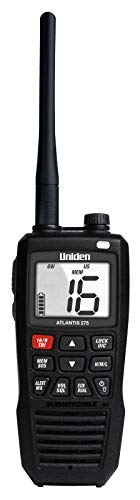
Uniden Atlantis 275 Handheld Two-Way VHF Marine Radio, Floating IPX8 Submersible Waterproof, Large Dual-Color Screen, 6-Watt, All USA/International/Canadian Marine Channels, NOAA Weather Alerts
Included for 'Best Handheld VHF Radios for Boating & Kayaks' because the listing specifies Floating IPX8 Submersible Waterproof and Large Dual-Color Screen, details this guide uses to compare options.
View on AmazonOur picks by boating situation
Best overall for emergency capability: Standard Horizon HX890
The HX890 is the strongest choice when a handheld radio is part of your safety plan rather than merely a convenient way to talk to another boat. It combines up to 6 watts of transmit power with a built-in GPS receiver, Digital Selective Calling (DSC), and a dedicated distress function.
DSC can send a digital distress alert containing your vessel identity and position when the radio is correctly registered, connected to GPS, and programmed with your Maritime Mobile Service Identity (MMSI) number. You still make a voice call afterward, but DSC can help alert compatible vessels and rescue services more quickly.
Its IPX8 water protection is a useful advantage for cockpit spray, heavy rain, and an accidental dunking. The radio also floats, which matters because a non-floating VHF can disappear immediately after going overboard. The trade-offs are greater size, higher cost, and a battery runtime that is shorter than the Icom IC-M37.
Best battery life: Icom IC-M37
The IC-M37 is a practical choice for long days aboard a boat, multi-day trips with limited charging, or users who spend much of the day monitoring channels. Its large-capacity battery and efficient design give it substantially more endurance than many compact handhelds.
It transmits at up to 6 watts and has IPX8-rated waterproofing and flotation. The radio is designed around clear communication and long operating time rather than navigation. It does not provide the HX890’s built-in GPS or DSC distress workflow, so it is best paired with a separate chartplotter, phone in a waterproof case, or another navigation system.
For routine communication, use 1 watt when the other station is nearby and reception is clear. Reserve 5 or 6 watts for distance, obstructions, or difficult conditions. Lower power reduces battery consumption and can reduce interference with nearby users.
Best lightweight option for kayaks: Icom IC-M25
The IC-M25 is easier to carry on a personal flotation device or in a kayak deck bag than larger GPS-equipped radios. It offers up to 5 watts, IPX7 waterproofing, flotation, and USB charging, while keeping weight and bulk relatively low.
IPX7 means the radio is designed to survive temporary immersion, commonly defined as immersion in about 1 metre of water for up to 30 minutes under laboratory conditions. It does not mean the radio is suitable for permanent submersion or that every connector can be left wet and open. Rinse saltwater away, dry the charging area, and close protective covers before exposure.
The IC-M25 has no DSC or built-in GPS. That is a reasonable compromise for short coastal paddles where the primary need is to contact a partner, marina, bridge tender, or nearby vessel. It is less suitable as the sole emergency device on remote or offshore routes.
Best budget floating radio: Cobra MR HH350 FLT
The MR HH350 FLT covers the essentials: selectable transmit power up to 6 watts, marine and weather channels, a floating design, and a relatively accessible price. It is suitable for occasional boating, family outings, and as a second radio for communication between a main vessel and a tender.
Its main limitation is the absence of built-in GPS and DSC. A floating design protects against loss after a drop, but it does not replace emergency signaling. Keep a charged phone, personal locator beacon, EPIRB, or other appropriate backup equipment when operating beyond easy help.
How much transmit power do you need?
More wattage does not automatically mean more range. A handheld VHF normally transmits at 1 watt or at a high-power setting around 5 or 6 watts. Range is strongly affected by antenna height, line of sight, weather, surrounding land, and the receiving station’s antenna.
- 1 watt: Useful for kayak-to-kayak or boat-to-boat communication at short distances.
- 2.5 to 3 watts: A middle setting on radios that offer it; useful when 1 watt is marginal.
- 5 to 6 watts: The normal high-power setting for contacting a distant vessel, marina, bridge, or coast station.
As a rough planning example, a kayak paddling close to a support boat may need only 1 watt. If the handheld antenna is approximately 1 metre above the water and the other vessel’s antenna is around 3 metres high, the radio-horizon estimate is about 2.3 nautical miles before terrain, waves, and obstructions are considered. Raising the antenna and maintaining line of sight often helps more than simply selecting maximum power.
DSC and GPS: useful safety features with setup requirements
DSC is valuable only when configured correctly. Before relying on it:
- Obtain and program the vessel’s MMSI number through the appropriate national authority.
- Enter the MMSI once and verify every digit; many radios restrict later changes.
- Go outdoors and confirm that the radio obtains a GPS position.
- Read the distress-alert procedure and understand the difference between an undisignated distress alert and a routine or safety call.
- Make a voice transmission after a distress alert, stating the vessel name, position, nature of the emergency, and assistance required.
A GPS-enabled VHF can display your position and transmit it through DSC, but it is not a substitute for navigation lights, a paper or electronic chart, or an independent distress beacon. Keep GPS permissions, antenna exposure, and battery condition in mind when planning.
Battery life on the water: a realistic planning method
Manufacturers commonly quote runtime using a duty cycle such as 5 percent transmit, 5 percent receive, and 90 percent standby. Real use can be harsher. If a radio is rated for 10 hours under a moderate duty cycle, a day with frequent conversations, high-power calls, loud audio, and poor reception may provide closer to 6–8 usable hours.
For an eight-hour outing, a conservative plan is to start with a full battery, use 1 watt for nearby communication, switch off unnecessary backlighting, and carry a second charged battery or charging solution. A 10-hour rated radio should not be treated as an eight-hour guarantee, especially in cold weather. Do not store a lithium-ion battery completely empty for long periods, and replace a pack that becomes swollen, unusually hot, or unable to hold a useful charge.
Durability and ownership details that matter
- Connector seals wear first: USB covers, accessory sockets, and battery gaskets can lose their seal after repeated opening or salt contamination.
- Saltwater requires rinsing: After exposure, rinse the exterior with fresh water according to the manual, wipe it dry, and leave covers open only while the charging area is drying.
- Do not test waterproofing casually: IP ratings are laboratory ratings, not permission to pressure-wash a radio or charge it while wet.
- Floatability is not recovery: A floating radio can still drift away, become hidden by waves, or suffer damage if the battery cover is not properly latched. Attach a suitable tether that does not obstruct controls.
- Use the correct antenna: Do not transmit with a damaged, missing, or poorly connected antenna. It can reduce range and may damage the transmitter.
- Keep the microphone clear: Water in the microphone opening can make transmissions sound muffled. Hold the radio upright and use the drain or water-ejection feature if the model provides one.
Bottom line
Choose the Standard Horizon HX890 if GPS and DSC are central to your emergency plan. Choose the Icom IC-M37 if maximum battery endurance and IPX8 protection matter more than built-in navigation. For a compact kayak radio, the Icom IC-M25 is a sensible lightweight choice, while the Cobra MR HH350 FLT offers the basic floating-radio package at a lower general market price. Whatever model you choose, learn Channel 16 procedures, keep the battery charged, and treat the handheld as one part of a complete on-water safety system.