Key takeaways
- Field of view: Around 120 degrees suits a compact rectangular room. Around 180 degrees works well when people sit close to a wall-mounted display. A 360-degree camera is useful for circular or irregular seating.
- Auto-framing: Look for group framing that keeps all visible attendees in the shot and speaker framing that can follow the person talking. Tracking is helpful, but rapid or unnecessary camera movement can distract remote participants.
- Microphone pickup: Check the stated pickup distance and whether expansion microphones are available. A camera that sees the entire room is not necessarily able to hear the farthest seat clearly.
- Room integration: USB cameras are flexible and relatively inexpensive. Appliance-style systems can run meeting software without a permanently connected laptop, but they cost more and require more careful compatibility checks.
The best conference room cameras for most teams are the Jabra PanaCast 50 for small-to-medium rooms, Logitech Rally Bar Mini for a polished all-in-one setup, Logitech Rally Bar for larger rooms, and Meeting Owl 3 when a 360-degree table view matters more than maximum video detail.
Quick picks by meeting-room situation
| Situation | Best fit | Why | Typical market range |
|---|---|---|---|
| Small room, one display, 2–6 people | Jabra PanaCast 50 | 180-degree view, 4K capture, strong automatic framing, integrated speakers | $500–$800 |
| Small room needing a dedicated room appliance | Logitech Rally Bar Mini | PTZ camera, 4K sensor, automatic framing, expandable microphones | $2,000–$3,000 |
| Medium or large rectangular room | Logitech Rally Bar | Wider room coverage, stronger speaker output, optional Rally Mic Pods | $3,000–$4,500 |
| Round table or hybrid meeting with people on every side | Meeting Owl 3 | 360-degree room view and speaker tracking without a traditional front-facing layout | $800–$1,200 |
What matters more than “4K”
Resolution is useful, particularly when participants need to read a whiteboard or see facial expressions from the far end of a room. It is not the deciding specification by itself. A 4K camera with a narrow field of view can leave people outside the frame, while a wide-angle camera may show everyone but make faces appear smaller.

4K Conference Room Camera System AI Auto-Tracking 4K PTZ Camera 3X Optical Zoom 93° Wide Angle USB3.0 HDMI Output and Wireless Bluetooth Speakerphone with Mics for Conferencing Worship Church Medical
Included for 'Best Conference Room Cameras: 4K & Wide-Angle Picks' as a relevant option in this category; details come from the product listing.
View on Amazon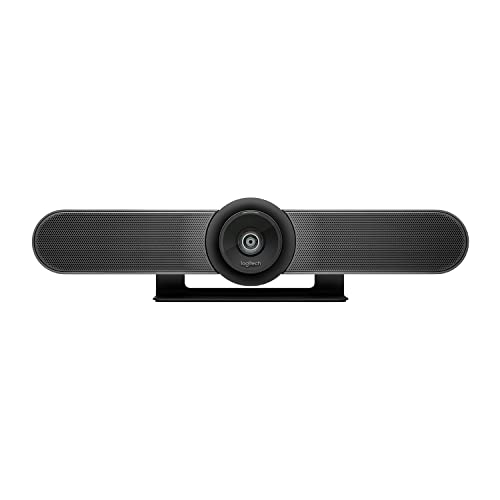
Logitech MeetUp Video Conferencing System 4K 3 Microphones - Black
Included for 'Best Conference Room Cameras: 4K & Wide-Angle Picks' because the listing specifies Black, details this guide uses to compare options.
View on Amazon
Owl Labs Meeting Owl 3 - 360° 1080p HD Conference Room Camera, AI-Driven Speaker-Tracking, 18-Foot Mic Pickup - Certified for Microsoft Teams - Works with Zoom, Google Meet - Plug & Play Setup
Included for 'Best Conference Room Cameras: 4K & Wide-Angle Picks' because the listing specifies 360° 1080p HD Conference Room Camera and AI-Driven Speaker-Tracking, details this guide uses to compare options.
View on Amazon
Yealink 4K Video Conference Camera System for PC, Huddle Room, Teams & Zoom
Included for 'Best Conference Room Cameras: 4K & Wide-Angle Picks' because the listing specifies Huddle Room and Teams & Zoom, details this guide uses to compare options.
View on Amazon- Field of view: Around 120 degrees suits a compact rectangular room. Around 180 degrees works well when people sit close to a wall-mounted display. A 360-degree camera is useful for circular or irregular seating.
- Auto-framing: Look for group framing that keeps all visible attendees in the shot and speaker framing that can follow the person talking. Tracking is helpful, but rapid or unnecessary camera movement can distract remote participants.
- Microphone pickup: Check the stated pickup distance and whether expansion microphones are available. A camera that sees the entire room is not necessarily able to hear the farthest seat clearly.
- Room integration: USB cameras are flexible and relatively inexpensive. Appliance-style systems can run meeting software without a permanently connected laptop, but they cost more and require more careful compatibility checks.
1. Jabra PanaCast 50: best for a small, wide room
The Jabra PanaCast 50 is a strong choice for a small meeting room where people sit in a single row or around a compact table. Its 180-degree horizontal field of view is its defining advantage: it can show people seated near the edges without requiring the camera to be placed unusually far back.
It uses a multi-camera design with 4K video processing, automatic framing, and a built-in speaker-and-microphone array. Jabra specifies microphone pickup up to approximately 4.5 metres, making it most appropriate for compact rooms rather than long boardrooms. The device is about 650 mm wide and weighs roughly 2.2 kg, so it is substantial enough for a wall mount but still manageable on a shelf.
Best for: two to six people, huddle rooms, and wide tables close to the screen.
Trade-off: A 180-degree view can make the room look more stretched at the sides. Its integrated microphone range is not a substitute for expansion microphones in a deeper room.
2. Logitech Rally Bar Mini: best polished all-in-one for small rooms
The Logitech Rally Bar Mini is better suited than a basic USB webcam when the room needs a permanent, professional installation. It combines a 4K camera, pan-and-tilt capability, automatic speaker framing, group framing, integrated speakers, and beamforming microphones. Logitech lists microphone pickup at about 4.6 metres, with optional Rally Mic Pods available when the table extends beyond that distance.
Its camera has a narrower view than the PanaCast 50, with a diagonal field of view of roughly 120 degrees. That is usually sufficient for a small room, especially when the camera is centred beneath a display. The unit is approximately 719 mm wide and weighs about 4.8 kg, so use a properly rated shelf or wall mount rather than a lightweight monitor ledge.
The Rally Bar Mini can operate in USB mode with a computer or as a supported room appliance, depending on the deployment and meeting platform. This flexibility helps a growing organisation avoid replacing the camera when its room-management approach changes.
Best for: two to six people who want automatic framing and a tidy, dedicated installation.
Trade-off: It costs substantially more than a simple USB camera, and the narrower field of view requires more precise placement.
3. Logitech Rally Bar: best for medium and large rooms
The full-size Logitech Rally Bar is the more suitable choice when participants sit several metres from the display or when a room has two seating rows. It provides 4K video, automatic framing, speaker tracking, integrated speakers, and a microphone pickup distance of approximately 4.6 metres from the bar itself. Rally Mic Pods can extend the practical seating area when positioned around the table.
Its camera offers a diagonal field of view of approximately 120 degrees and a longer optical reach than the Mini. That extra reach helps remote attendees see people at the far end of the room without relying entirely on digital cropping. The bar is roughly 164 mm high, 910 mm wide, and 130 mm deep, with a weight close to 5.9 kg.
Best for: medium conference rooms, rooms with two rows, and organisations that may add expansion microphones later.
Trade-off: The built-in microphone distance is still finite. For a long table, budget for microphones rather than assuming the larger chassis automatically solves audio coverage.
4. Meeting Owl 3: best for 360-degree participation
The Meeting Owl 3 takes a different approach. Instead of pointing at the front of the room, it sits in the centre of the table and creates a 360-degree view, while showing the current speaker in a larger panel. It is particularly useful when local participants face one another or when a room does not have a natural “front.”
Owl Labs specifies microphone pickup up to approximately 5.5 metres. The camera is designed around a 360-degree panoramic view and speaker switching rather than a conventional 4K front-facing image, so it is not the best pick when remote viewers need highly detailed whiteboard content or close facial detail.
Best for: round tables, classrooms, collaborative spaces, and meetings where people speak from different directions.
Trade-off: The split-view presentation can feel less natural than a front-facing camera, and the central unit occupies table space. Place it where laptops, notebooks, and drinks will not obstruct its microphones or lenses.
Decision matrix: match the camera to the room
| Your priority | Choose | Reason |
|---|---|---|
| Lowest cost while covering a wide small room | Jabra PanaCast 50 | Wide 180-degree framing reduces the need for multiple cameras. |
| Frequent meetings with minimal operator involvement | Rally Bar Mini or Rally Bar | Automatic framing and room-appliance options simplify repeat use. |
| People sit at both ends or around all sides | Meeting Owl 3 | 360-degree capture avoids leaving side participants off-screen. |
| Long table or two seating rows | Rally Bar with expansion microphones | Supports a more deliberate audio layout and longer camera reach. |
| Whiteboard and fine detail are central to meetings | 4K front-facing camera | Choose PanaCast 50, Rally Bar Mini, or Rally Bar over a 360-degree-first design. |
How to size microphone coverage before buying
Measure the distance from the proposed camera or microphone position to the farthest regular speaker, not merely the room’s wall-to-wall dimensions. For example, if the table is 7 metres long and the camera sits at one end, the farthest participant may be 6 metres away after accounting for chair position. A camera rated for 4.5–4.6 metres will not provide comfortable audio coverage at that seat without an expansion microphone.
For a four-metre table with the camera centred on the short wall, the farthest speaker may be about 3.5 metres away. That is within the stated pickup range of the PanaCast 50, Rally Bar Mini, and Rally Bar, assuming the room is not unusually noisy. Hard walls, air conditioning, keyboard noise, and people talking over one another reduce real-world clarity, so treat manufacturer distances as planning limits rather than guarantees.
Installation and ownership details
- Position the lens near eye level and as close to the display as practical. A camera too high makes participants appear to look downward; one too low exaggerates the table.
- Keep the primary microphone path clear. Do not hide the unit behind a monitor, soundbar grille, stack of folders, or decorative panel.
- Use the narrowest field of view that includes everyone. Excessively wide framing makes faces smaller and captures distracting doorways.
- Clean lenses with a dry, soft microfiber cloth. Do not spray cleaner directly onto the camera or microphone openings.
- Expect mounts, cables, and microphone pods to wear before the camera itself. Label cables during installation so a replacement does not require rebuilding the entire room.
- Update firmware and check framing behaviour after updates. Automatic tracking settings can change, and privacy shutters or lens covers should be checked before important meetings.
Final recommendation
Choose the Jabra PanaCast 50 when wide coverage in a small room is the priority and you want to keep spending controlled. Choose the Rally Bar Mini for a more formal, expandable room installation, and the Rally Bar when the room is deeper or used continuously. Select the Meeting Owl 3 when participation comes from every direction and its 360-degree layout is more valuable than maximum front-facing detail.
Before ordering, sketch the table, mark the camera position, measure the farthest speaker, and confirm the meeting platform’s supported USB or appliance mode. Those three checks—field of view, microphone distance, and deployment method—will usually matter more than the headline 4K specification.