Key takeaways
- Bed frame: Confirm whether the headboard, footboard, side rails, center support, and slats are included. A platform bed may not require a box spring, but a panel bed often has different support requirements.
- Nightstands: Two matching nightstands improve symmetry, but one is often more practical in a small room. Look for at least 20–24 inches of width if you need a lamp, phone, and book.
- Dresser: Six drawers are useful for folded clothing, while a wide three-drawer dresser often provides deeper storage for bulky items.
- Mirror: A mirror may be designed to attach to the dresser. Do not assume it can be safely mounted on a wall without checking its hardware and weight.
- Chest: A tall chest is valuable when floor space is limited, but its narrow footprint makes it less suitable for shared clothing storage.
The best bedroom sets for small rooms are compact, modular sets with a narrow bed, vertical storage, and shallow drawers, while larger rooms benefit from a coordinated bed, two nightstands, a wider dresser, and storage that fills the wall without making the room feel unfinished.
Best bedroom sets by room size
| Room situation | Recommended set | Typical furniture footprint | Best feature | Main compromise |
|---|---|---|---|---|
| Small bedroom, up to 100 sq. ft. | Full or twin bed, one nightstand, tall chest | Bed: 39–57 in. wide; storage depth: 16–20 in. | Uses wall height instead of floor area | Less bedside surface and drawer capacity |
| Average bedroom, 100–160 sq. ft. | Queen bed, two nightstands, six-drawer dresser | Bed: 63–69 in. wide; dresser depth: 18–21 in. | Balanced storage and comfortable circulation | Requires careful door and closet clearance |
| Large bedroom, more than 160 sq. ft. | King bed, two nightstands, wide dresser, chest or bench | Bed: 79–81 in. wide; dresser width: 60–72 in. | Proportional scale and generous storage | Higher price, heavier pieces, more assembly |
What should a bedroom set include?
Bedroom sets are usually sold in combinations rather than as a complete room. A “three-piece” set commonly means a bed, one dresser, and a mirror, while a “four-piece” set may add one nightstand or replace the mirror with a second nightstand. Check the contents before comparing prices.

AMERLIFE 5-Piece Farmhouse Bedroom Set, Queen Bed Frame & Dresser, Grey
Included for 'Best Bedroom Sets for Small and Large Rooms' because the listing specifies Queen Bed Frame & Dresser and Grey, details this guide uses to compare options.
View on Amazon
AMERLIFE 5-Piece Farmhouse Bedroom Set, Rustic Wood King Bed Frame with 51" Tall Headboard, 6-Drawer Dresser, 5-Drawer Tall Chest, Nightstands Set of 2 with Charging Station, White
Included for 'Best Bedroom Sets for Small and Large Rooms' because the listing specifies Rustic Wood King Bed Frame with 51" Tall Headboard and 6-Drawer Dresser, details this guide uses to compare options.
View on Amazon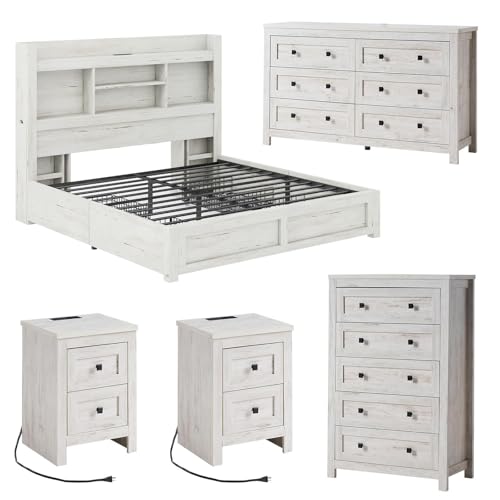
LUXOAK 5-Piece Farmhouse Bedroom Set - Queen Storage Bed & Dresser, White
Included for 'Best Bedroom Sets for Small and Large Rooms' because the listing specifies Queen Storage Bed & Dresser and White, details this guide uses to compare options.
View on Amazon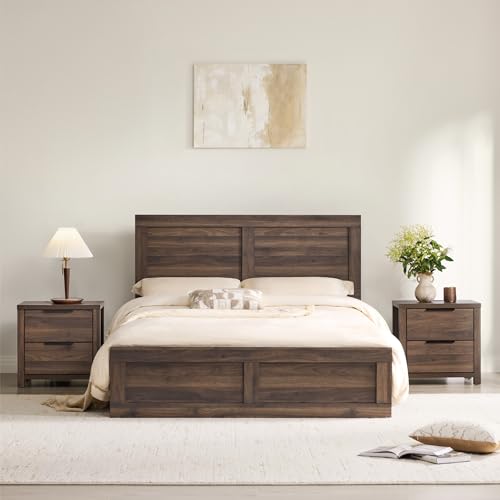
KISLOT 3-Piece Bedroom Set, Bed Frame & 2 Nightstands, Walnut, Queen
Included for 'Best Bedroom Sets for Small and Large Rooms' because the listing specifies Bed Frame & 2 Nightstands and Walnut, details this guide uses to compare options.
View on Amazon- Bed frame: Confirm whether the headboard, footboard, side rails, center support, and slats are included. A platform bed may not require a box spring, but a panel bed often has different support requirements.
- Nightstands: Two matching nightstands improve symmetry, but one is often more practical in a small room. Look for at least 20–24 inches of width if you need a lamp, phone, and book.
- Dresser: Six drawers are useful for folded clothing, while a wide three-drawer dresser often provides deeper storage for bulky items.
- Mirror: A mirror may be designed to attach to the dresser. Do not assume it can be safely mounted on a wall without checking its hardware and weight.
- Chest: A tall chest is valuable when floor space is limited, but its narrow footprint makes it less suitable for shared clothing storage.
Best bedroom sets for small rooms
Choose a full bed set when two people share the room
A full mattress is 54 by 75 inches, compared with 60 by 80 inches for a queen. That saves 6 inches of width and 5 inches of length, which can make a meaningful difference near a closet or doorway. A full-size bed set with one narrow nightstand and a tall chest is usually more space-efficient than a queen set with two large nightstands.
Leave approximately 24 inches of walking space beside the bed where possible. Around 30–36 inches is more comfortable, especially near drawers. Measure the room with the drawers open, not just with the furniture closed. A dresser that fits against a wall may block the bed when its drawers extend 15–18 inches.
Choose a twin set for a child, guest room, or flexible space
A twin mattress is 38 by 75 inches, so a twin bed can free enough floor area for a desk, play space, or reading chair. Look for a set with under-bed drawers or a lift-up platform if you need storage. However, under-bed storage is only useful when the bed can be pulled away from the wall or the drawers open fully into the room.
For a child’s room, prioritize sturdy rails, rounded edges, replaceable hardware, and an appropriate mattress foundation over decorative extras. A very tall dresser may provide more storage but is harder to use safely; anchor tall furniture to the wall according to the manufacturer’s instructions.
Best bedroom sets for large rooms
A large room needs furniture with enough visual and physical scale. A king bed is 76 by 80 inches, and a California king is 72 by 84 inches. A small dresser paired with a large bed can make the room look unbalanced, even when it leaves plenty of walking space.
For a primary bedroom, a practical large-room combination is a king bed, two nightstands at least 24 inches wide, a six- or eight-drawer dresser, and a separate chest or wardrobe. Keep approximately 30–36 inches around the main walking paths. If you place a bench at the foot of the bed, allow at least 24 inches between the bench and the nearest obstruction, and more if the bench has storage that opens forward.
Wide dressers typically offer easier access than tall chests because every drawer is within reach. Choose a chest when the room has limited usable wall width, or when you want to keep a long wall available for a television or artwork.
Materials: which construction is worth paying for?
| Material or construction | Typical durability | Care needs | Best use |
|---|---|---|---|
| Solid wood | High; often repairable and refinishable | Use a soft, slightly damp cloth; avoid standing water | Long-term ownership and heavy daily use |
| Wood veneer over engineered wood | Moderate to high when edges are sealed | Protect from moisture and heat | Natural appearance at a lower weight and price |
| Laminated particleboard or MDF | Moderate; vulnerable to swelling if wet | Wipe spills immediately; do not drag assembled pieces | Budget sets and occasional-use rooms |
| Metal frame with wood or composite panels | Moderate to high, depending on joints | Check bolts periodically; prevent rust in damp rooms | Industrial styles and lighter visual designs |
Inspect the details that wear first: drawer bottoms, drawer runners, bed-center supports, veneer edges, and screw joints. Metal ball-bearing runners generally tolerate frequent use better than basic plastic rollers. For a bed, a center rail with legs is important on full, queen, king, and California king frames; unsupported spans can lead to noise, sagging, or loose joints.
Storage capacity matters more than drawer count
Two dressers can both advertise six drawers while offering very different usable space. Compare internal drawer width, depth, and height. A drawer measuring 26 by 14 by 5 inches holds approximately 1,820 cubic inches before accounting for the runners and usable clearance. Six drawers of that size provide about 10,920 cubic inches, or roughly 6.3 cubic feet.
That calculation helps explain why a tall six-drawer chest may not replace a wide dresser: its drawers can be narrower and less convenient for folded clothing. Also check whether the top drawers are shallow jewelry drawers or full-height drawers. A mirror attached to the dresser can use less floor space, but it may prevent you from placing the dresser beneath a low window.
Assembly and delivery checklist
- Measure the package route, including stair turns, elevator dimensions, and the narrowest doorway. The assembled furniture may fit while the boxed panels do not.
- Expect roughly 30–90 minutes for a nightstand, 60–150 minutes for a dresser, and 2–4 hours for a bed, depending on the number of parts and whether a second person is needed.
- Use a level surface and do not fully tighten every fastener until the frame is aligned. This reduces gaps and prevents drawers from sitting crooked.
- Install anti-tip hardware on tall chests and dressers. Anchor the piece before loading drawers.
- Retighten bed hardware after several weeks of use, then check it every few months if the frame develops movement or noise.
- Keep the instructions and spare hardware. Replacement screws and drawer parts can be difficult to identify without the original documentation.
A simple decision matrix
| Your priority | Choose | Avoid |
|---|---|---|
| Lowest upfront cost | Engineered-wood set with a simple platform bed | Oversized sets with mirrors, benches, and decorative panels |
| Smallest footprint | Twin or full bed, one nightstand, tall chest | Deep dressers and two wide nightstands |
| Frequent daily use | Solid wood or well-built veneer, reinforced bed rails, metal drawer runners | Thin drawer bottoms and unsupported bed slats |
| Moving within a few years | Modular pieces with removable legs and separate headboard | Very heavy one-piece dressers and permanently attached mirrors |
| Maximum clothing storage | Wide dresser plus chest, measured by internal capacity | Choosing by drawer count alone |
Final buying recommendation
For most small rooms, choose a full or twin set with one nightstand, a tall chest, and storage no deeper than about 20 inches. For an average room, a queen set with two nightstands and a six-drawer dresser offers the best balance. For a large room, select a king set with two substantial nightstands, a wide dresser, and a separate chest or wardrobe.
Before ordering, confirm the mattress size, bed-support requirements, interior drawer dimensions, finished furniture dimensions, assembly service options, and delivery route. The best bedroom sets are not necessarily the ones with the most pieces; they are the sets whose proportions, storage, materials, and maintenance demands match the room and the way you use it.