Key takeaways
- Measure the route: Measure the narrowest doorway, the turning space near furniture, and the place where the walker will be stored. Compare those figures with the product’s full width and length—not just its folded dimensions.
- Check the handle: The child should be able to hold it with elbows comfortably bent and shoulders relaxed. Avoid a handle so high that the child has to reach up or lean forward.
- Assess rolling resistance: On a clear, level floor, an adult can check whether the wheels move gradually rather than surging with a small push. Follow the maker’s instructions for adjusting resistance; do not improvise with tape, wedges, or added weights.
- Check stability: Look for a wide wheelbase and a frame that does not rock or tip when nudged from different sides. Follow the manufacturer’s age, height, and weight limits.
- Plan the play area: Keep stairs, thresholds, rugs that bunch, cords, heaters, glass doors, and sharp-edged furniture out of the route. Use a level floor and stay close enough to intervene.
Choose by walking stage: seated walkers are activity stations; push walkers are cruising aids
The best baby walkers for most families are stable push walkers used by a baby who can already pull to stand and cruise along furniture; seated walkers are a different, higher-risk product category and are best skipped. A seated walker suspends a baby in a wheeled frame so they can move before walking independently. A push walker is a weighted toy or handlebar the child moves while standing. Neither teaches a baby to walk, and neither is a substitute for close supervision or a childproofed space.
If you are comparing options, prioritize the child’s current abilities and the room they will use—not the number of toys attached. The table below gives practical screening targets for common designs; exact dimensions and weights vary by model, so confirm them on the product’s packaging or manufacturer page.

Smart Steps Trend Activity Walker with Removeable Toy Bar, Multi-Directional Front Wheels, Tray, Adjustable Height and Flat Fold Frame for Storage, Ages 6 Months +, Emily Pink
Included for 'Best Baby Walkers: Seated and Push Options Compared' because the listing specifies Multi-Directional Front Wheels and Tray, details this guide uses to compare options.
View on Amazon
Smart Steps Trend Activity Walker and Entertainer with Removeable Toys, Large Tray, Cup Holder, Adjustable Height and Flat Fold Frame for Storage, Ages 6 Months +, Space Walk Navy
Included for 'Best Baby Walkers: Seated and Push Options Compared' because the listing specifies Large Tray and Cup Holder, details this guide uses to compare options.
View on Amazon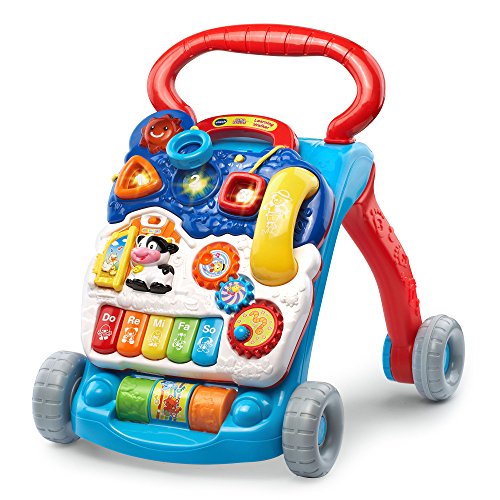
VTech Sit-to-Stand Learning Walker (Frustration Free Packaging), Blue
Included for 'Best Baby Walkers: Seated and Push Options Compared' because the listing specifies Blue, details this guide uses to compare options.
View on Amazon
Ingenuity Smooth Strides Activity Baby Walker - Chambray, Developmental Walker, 3 Adjustable Heights, Toys Included, 6M-12M
Included for 'Best Baby Walkers: Seated and Push Options Compared' because the listing specifies Chambray and Developmental Walker, details this guide uses to compare options.
View on AmazonSeated vs. push walkers: the practical differences
| Feature | Seated walker | Push walker |
|---|---|---|
| Typical product footprint | About 60–75 cm wide and 65–80 cm long | About 30–45 cm wide and 35–50 cm long |
| Typical product weight | About 4–7 kg | About 2–5 kg |
| Child’s position | Seated in a fabric or molded seat, feet reaching the floor | Standing behind or holding a handle |
| Useful ability prerequisite | No walking skill required; that is not a safety advantage | Pulling to stand and beginning to cruise are sensible readiness signs |
| Maneuverability | Can roll quickly and turn into furniture, doorways, or stairs | Usually slower, but can still roll away or tip if poorly balanced |
| Storage | Often folds, but remains bulky; check folded width and locking mechanism | Usually easier to park; some models fold or have a removable handle |
| Safety decision | Health authorities, including the American Academy of Pediatrics, advise against wheeled seated walkers | Use only with supervision, on a clear, level surface, and in a design that resists tipping |
These measurements are comparison ranges, not universal specifications. In particular, a compact-looking seated walker may still be wider than a standard interior doorway. Seated walkers can also give babies access to hazards they could not otherwise reach, including stairs, hot drinks, cords, and objects on low tables. A stair barrier does not remove the risk of collisions or access to other hazards.
Which option fits your situation?
| Your situation | More suitable choice | Why |
|---|---|---|
| Baby cannot pull to stand or cruise | Neither; choose supervised floor play instead | A walker is not a developmental shortcut. Let readiness come from the child’s own movement. |
| You want an option for early standing practice | Stable push walker, once the child pulls up and cruises | It supports a standing activity without carrying the child in a rolling seat. |
| Small apartment, narrow doorways, limited storage | Compact push walker—or no walker | A seated model’s wide frame takes more room and can be difficult to maneuver or store. |
| Frequent use in a busy, shared room | Neither as a way to occupy a child unattended | Both require an adult nearby; floor play in a cleared area is easier to supervise. |
| Lowest-cost option is the priority | Consider a simple push toy, or skip the purchase | Pay for stability and adjustable resistance rather than lights or extra activities. |
| Seated walker offered secondhand or by family | Decline it | Its core risks are tied to the wheeled seated design, not just age, condition, or brand. |
A push walker is not automatically safe just because it is upright. For a beginner, look for a broad base, a low center of gravity, a handle the child can hold without stretching, and wheels with adjustable resistance or a controlled roll. A lightweight cart that shoots forward on a smooth floor may be harder to manage than a heavier, slower design.
How to check fit and maneuverability at home
- Measure the route: Measure the narrowest doorway, the turning space near furniture, and the place where the walker will be stored. Compare those figures with the product’s full width and length—not just its folded dimensions.
- Check the handle: The child should be able to hold it with elbows comfortably bent and shoulders relaxed. Avoid a handle so high that the child has to reach up or lean forward.
- Assess rolling resistance: On a clear, level floor, an adult can check whether the wheels move gradually rather than surging with a small push. Follow the maker’s instructions for adjusting resistance; do not improvise with tape, wedges, or added weights.
- Check stability: Look for a wide wheelbase and a frame that does not rock or tip when nudged from different sides. Follow the manufacturer’s age, height, and weight limits.
- Plan the play area: Keep stairs, thresholds, rugs that bunch, cords, heaters, glass doors, and sharp-edged furniture out of the route. Use a level floor and stay close enough to intervene.
For a seated product already in the home, the safest choice is to stop using it rather than trying to make it safe with added supervision or a gated room. If you need a place to set a baby down, consider a stationary, age-appropriate play space and follow its instructions for use.
Ownership details that matter more than extra features
On a push walker, wheels and their resistance mechanism are likely to show wear first, especially with frequent use on rough flooring. Check periodically for loose fasteners, cracks, sharp edges, and wheels that have become uneven or too free-rolling. Stop using the toy if a part is damaged or missing, and use only manufacturer-approved replacement parts.
Activity panels and handles collect drool, food, and floor dust. Choose a design with surfaces that can be wiped clean, and check whether any fabric parts are removable and washable. Avoid soaking wooden products or using cleaners not permitted by the maker; moisture and harsh products can damage finishes and joints. Small detachable pieces also need checking against the product’s age guidance and choking-hazard warnings.
Before buying used, verify the exact model and check the manufacturer’s recall information for your country. Do not use a product with missing instructions, a broken locking mechanism, unstable wheels, or a history you cannot verify. For a seated walker, however, good condition does not change the recommendation to avoid the category.
Bottom line
For a baby who is not yet standing and cruising, skip walkers and make a safe floor area available for movement. Once a child is ready to pull up and cruise, a stable, slow-rolling push walker can be an optional supervised play toy—provided it fits the child and the room. Seated walkers are not the safer choice for younger babies: their speed, reach, and access to hazards make them a category families should avoid.