Key takeaways
- For occasional checks and limited storage: Look for a compact digital infant scale with a stable, wide tray. Compare its footprint with your available shelf or cupboard space, and check whether the tray detaches for storage.
- For frequent measurements requested by a clinician: Prioritize a clear display, fine increments, repeatable placement, and a tare function. Ask the clinician whether the scale’s resolution and your weighing schedule are appropriate; more frequent weighing is not automatically more useful.
- For a baby who won’t stay still: Choose a shallow, broad tray with raised edges and a hold function. A hold function can help capture a reading after brief movement, but it doesn’t make an unsafe setup safe or turn a fluctuating measurement into a reliable trend.
- For use into toddlerhood: Compare maximum capacity and whether the infant tray comes off. A larger stated capacity can extend use, but don’t put a standing child on an infant tray unless the manual explicitly permits it.
- For the lowest-cost option: A basic infant scale may be enough if it has a non-slip base, readable display, and suitable capacity. General market prices range from roughly $30–$70 for basic models to $70–$150 or more for feature-rich or professional-style models. Prices vary; a higher price does not guarantee a better fit.
The best baby scale for most families is a stable digital infant scale with a removable tray, a 20–22 lb (9–10 kg) capacity, and 0.5 oz (10 g) increments; choose a higher-capacity model if you expect to weigh your child beyond infancy or need to weigh a child with an adult scale later. A home scale can help you record weights consistently, but it cannot diagnose a feeding or growth concern. If you’re weighing because a clinician has asked you to monitor your baby, ask them which scale and schedule to use.
Baby scale options at a glance
The specifications below describe common product types, not guarantees for every model. Check the manufacturer’s manual for the exact capacity, increment, dimensions, cleaning instructions, and whether a stated accuracy figure applies across the full weighing range. A displayed increment is the smallest change shown; it is not proof that the measurement is accurate to that amount.

Beurer BY80 Digital Baby Scale, Infant Scale for Weighing in Pounds, Ounces, or Kilograms up to 44 lbs with Hold Function, Pet Scale for Cats and Dogs Analysis
Included for 'Best Baby Scales for Tracking Your Baby’s Growth at Home' because the listing specifies Infant Scale for Weighing in Pounds and Ounces, details this guide uses to compare options.
View on Amazon
Momcozy Baby Scale, Weight, Height and Weighted Feeds, Removable Tray,
Included for 'Best Baby Scales for Tracking Your Baby’s Growth at Home' because the listing specifies Weight and Height and Weighted Feeds, details this guide uses to compare options.
View on Amazon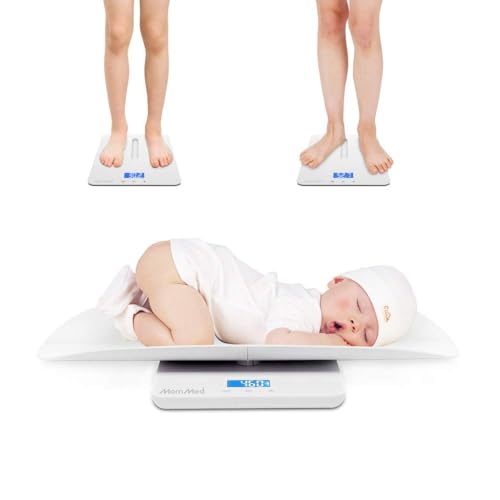
MomMed Baby Scale, Multi-Function Toddler Scale, Baby Scale Digital, Pet Scale, Infant Scale with Hold Function, Blue Backlight, Weight and Height Track
Included for 'Best Baby Scales for Tracking Your Baby’s Growth at Home' because the listing specifies Multi-Function Toddler Scale and Baby Scale Digital, details this guide uses to compare options.
View on Amazon
Greater Goods Digital Baby Scale for Infants & Toddlers, Non-Connected
Included for 'Best Baby Scales for Tracking Your Baby’s Growth at Home' because the listing specifies Non-Connected, details this guide uses to compare options.
View on Amazon| Scale type | Typical capacity | Typical display increment | Stability and wriggling | Best fit |
|---|---|---|---|---|
| Dedicated digital infant scale | 20–44 lb (9–20 kg) | 0.2–0.5 oz (5–10 g) | A broad tray helps; a hold or tare function may settle a moving reading, but movement can still affect it. | Regular infant weighing, especially when a clinician recommends home tracking |
| Mechanical baby scale | Often around 20–30 lb (9–14 kg) | Varies; commonly less fine than digital models | Can be sturdy, but the pointer may be harder to read while a baby moves. | Families who prefer a battery-free device and don’t need fine increments |
| Convertible infant-and-toddler scale | Often around 40–60 lb (18–27 kg) | Commonly 0.2–0.5 oz (5–10 g) in infant mode | Removable tray offers flexibility; check that it locks securely and the base stays level. | Families wanting a longer usable range and having room to store the tray |
| Adult bathroom scale with a weigh-hold or caregiver subtraction method | Commonly 300–400 lb (136–181 kg) for the adult scale | Often 0.1–0.2 lb (50–100 g) | Not designed to contain or safely support a baby; readings can vary when either person moves. | Occasional rough tracking only, if a clinician agrees it is suitable |
Among dedicated options, Health o meter and Tanita are established scale brands with infant-scale products. Models and specifications vary by market and may change, so use the comparison criteria above rather than assuming every product from a brand has the same features.
Choose by how you’ll actually use it
- For occasional checks and limited storage: Look for a compact digital infant scale with a stable, wide tray. Compare its footprint with your available shelf or cupboard space, and check whether the tray detaches for storage.
- For frequent measurements requested by a clinician: Prioritize a clear display, fine increments, repeatable placement, and a tare function. Ask the clinician whether the scale’s resolution and your weighing schedule are appropriate; more frequent weighing is not automatically more useful.
- For a baby who won’t stay still: Choose a shallow, broad tray with raised edges and a hold function. A hold function can help capture a reading after brief movement, but it doesn’t make an unsafe setup safe or turn a fluctuating measurement into a reliable trend.
- For use into toddlerhood: Compare maximum capacity and whether the infant tray comes off. A larger stated capacity can extend use, but don’t put a standing child on an infant tray unless the manual explicitly permits it.
- For the lowest-cost option: A basic infant scale may be enough if it has a non-slip base, readable display, and suitable capacity. General market prices range from roughly $30–$70 for basic models to $70–$150 or more for feature-rich or professional-style models. Prices vary; a higher price does not guarantee a better fit.
What matters beyond the numbers on the box
Capacity and increments
Choose a maximum capacity that comfortably covers your child’s expected use, rather than one that just meets their current weight. Check whether the stated increment changes at different weights. For tracking, consistency of setup and timing often matters more than buying the scale with the smallest advertised increment.
Stability and safe positioning
Look for a broad, rigid platform, a stable base, and a tray large enough for your baby to lie comfortably within its edges. Place the scale on a firm, level floor or counter only if the manufacturer allows that surface. Never leave a baby unattended on a raised surface, even briefly; weighing on the floor reduces fall risk. Keep hands close for safety without touching the baby or tray during the reading.
Ease of cleaning and ownership
Babies can spit up or have diaper leaks, so check whether the tray can be wiped clean and whether liquid can reach the controls or seams. Use only the cleaning method specified in the manual; harsh cleaners and soaking can damage sensors or finishes. Batteries are a recurring cost, and a low-battery warning or inconsistent display is a reason to replace them before comparing readings. Store the scale dry, avoid dropping it, and check the manufacturer’s instructions for calibration or service. A loose tray, damaged feet, or a scale that won’t return to zero can undermine repeatability.
How to get a more consistent home reading
- Set up the scale: Put it on a firm, level surface, away from drafts and vibration. Check that the tray is secure and the display reads zero.
- Use the same conditions: If you are tracking a trend, weigh at a consistent time and with similar clothing and diaper conditions. Clothing and a full diaper add weight.
- Use tare appropriately: If the manual allows it, place a light blanket on the tray and tare the scale before placing your baby. Don’t use bulky bedding or anything that could cover the face or interfere with safe positioning.
- Wait for a stable reading: Place your baby centered and within the tray. Keep them safe, and use the hold function only as described by the manufacturer. If readings jump around, let the scale reset and try again rather than choosing the number you prefer.
- Record the context: Note the date, reading, clothing or diaper conditions, and any relevant instructions from your clinician. Avoid interpreting a single change in isolation.
What a home scale can—and can’t—tell you
A scale gives a weight reading at one moment. Repeated readings made under similar conditions may help you and your clinician discuss a trend. Weight alone does not explain why a baby gained or lost weight, assess milk transfer, measure hydration, or establish whether feeding is going well. A home device may also differ from a clinic scale because of calibration, surface, clothing, and measurement conditions.
For a weighted feed—comparing a baby’s weight before and after nursing—ask a lactation professional or clinician which equipment and protocol to use. Small differences can be difficult to interpret, and an ordinary home scale may not have suitable precision. Contact your baby’s healthcare professional with concerns about feeding, output, weight changes, or growth; don’t delay care to collect more home readings.
Bottom line
For most families who have a reason to weigh at home, the best baby scale is a stable digital infant model with a secure tray, clear display, and suitable capacity—not necessarily the one with the most features or finest advertised increment. Choose a compact model for occasional use, a higher-capacity convertible model for longer use, and follow a clinician’s guidance when tracking is connected to a health concern.